
Mold Flow Simulation –
Precision Starts Before Production
At Layana, every successful molding project begins long before steel is cut. Our simulation service transforms design intent into manufacturable reality—delivering high-quality parts, stable cycle times, and cost-efficient production from day one.
Engineering Insight Meets Manufacturing Experience
With over four decades of precision manufacturing experience across metal stamping, plastic injection molding, insert molding and overmolding, and assembly, Layana integrates advanced simulation with real-world production know-how. We bridge the gap between digital prediction and physical performance.
Full-Service Manufacturer, Not Just a Consultant
Unlike stand-alone simulation consultants, Layana is a full-service manufacturer. Our in-house expertise covers tooling, molding, and assembly—meaning our simulation results are grounded in real production data, not just software outputs. Every simulation is supported by tooling engineers who understand what happens on the shop floor.
Reduce Tooling Risk and Lead Time
Tooling is one of the largest upfront investments in injection molding. Our mold flow simulation minimizes this risk by revealing potential problems before they reach the toolroom—unbalanced filling, air traps, weld lines, sink marks, or excessive pressure requirements—so you shorten validation cycles and accelerate your launch.
Optimized for Quality, Efficiency, and Cost
Whether you're targeting thinner walls, faster cycle times, or improved dimensional stability, we validate design and process parameters to ensure repeatable, high-quality production. Our simulations help achieve the ideal balance between quality and productivity before a single tool is cut.
What Layana's Mold Flow Simulation Covers
Our engineers perform complete virtual molding trials that evaluate every critical aspect of fill, pack, cooling, and warp—plus insert and overmold interaction. Every report includes actionable recommendations for geometry refinement, gate placement, and process optimization.
- Filling behavior and flow length
- Pressure drop and gate balance
- Weld line formation and air trap detection
- Packing and cooling efficiency
- Shrinkage and warpage prediction
- Gate location and runner configuration
- Venting recommendations and cavity balancing
- Pre-mold and overmold interaction
- Metal-to-plastic interface adhesion analysis
- Insert thermal gradients and displacement (FSI)
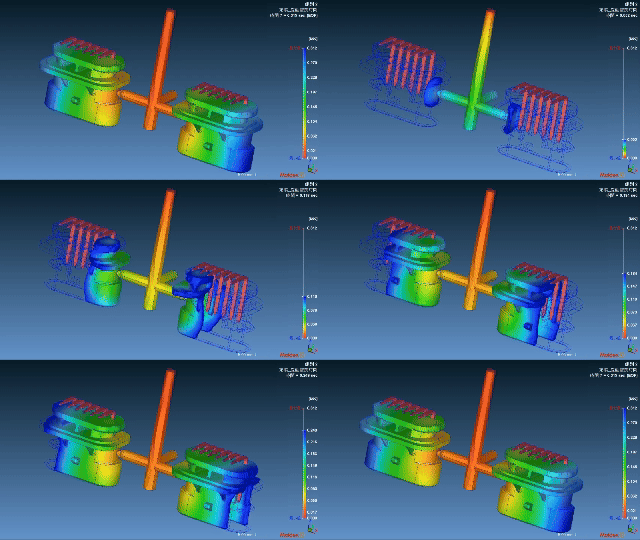
Fill time, Pressure at EOF, Air traps, Weld lines, Shear rate — the anchor outputs for early defect prediction, each linked to specific design and process actions.
Sink marks index, Volumetric shrinkage, Gate freeze criteria — pack-phase metrics that drive packing time and runner/gate geometry decisions.
Time to reach ejection temperature, Warpage / NMD indicator — thermal and dimensional outputs that close the loop between simulation and production targets.
Re-melt zone (overmolding), Insert temperature maps — multi-material outputs that quantify adhesion risk and thermal coupling before tooling.
Turning Data into Results
Our process spans four tightly integrated phases—from pre-validation to production correlation. Each phase is designed to eliminate hidden risk and compress the time from concept to first good part.
We ensure CAD data is simulation-ready and tooling-compatible: correcting mesh issues, checking draft angles, optimizing wall thickness, and validating gating and ejection schemes before tool fabrication.
Each simulation uses verified material data—viscosity, shrinkage, and cooling characteristics—sourced directly from resin manufacturers. We model PP, PC, ABS, PA6, PA66, PBT, PPS, among others, and engineering-grade polymers.
Full Fill/Pack/Cool/Warp analysis with iterative design and process adjustments. Actionable reports with gate relocation, runner redesign, cooling optimization, and packing profile recommendations.
Simulation predictions are validated against the physical mold filling study. Real temperatures, machine curves, and material behavior feed back into the model to align the virtual with the real.
Supported Materials
We analyze thermoplastics commonly used in automotive, electronics, medical, and industrial applications. Some of the supported materials include, but are not limited to:
Micro-tolerance capability on qualifying geometries. Layana aligns simulation results with real-world tooling and molding performance, ensuring the virtual model reflects what will actually come off the press.
From CAD to Validated Production
Eight integrated steps from submission to production sign-off. Click any stage to expand the detail.
Defects We Detect and Prevent
Mold flow simulation identifies and resolves the most common and costly injection molding defects before tooling begins. The following are the issues our engineers address on every project—each with specific simulation outputs and corrective actions.
Click any defect to expand causes, simulation outputs, and recommended actions.
Converging flow fronts with no air escape path; insufficient venting; injection speeds that seal the front before air can exit; poor parting line design.
Air traps; Air traps including air vents; Vent region pressure. In severe cases, compressed air causes surface burn marks through adiabatic heating.
Surface defects, burn marks, incomplete fill, and localized material degradation. A defect that is invisible in CAD but predictable in simulation.
Relocate or add gates; add/adjust venting; modify wall thickness to guide fronts; profile injection speed to prevent premature sealing.
Multi-gating; inserts splitting the flow front; cold thermal windows; low local pressure; unfavorable fiber orientation at the meeting point.
Weld lines (convergence angle); Weld and meld lines. Documented strength reductions of 12–56% depending on glass fiber content.
In areas with torque requirements or pull-out force (e.g., bushing inserts), weld lines must be eliminated or relocated. Fiber at the weld interface aligns parallel—losing its reinforcing function entirely.
Reposition gates to move weld lines to non-critical or hidden zones; increase Tmelt/Tmold; apply varioterm where needed; add flow leaders to improve meeting angle.
Hot core at thick sections; oversized ribs; insufficient packing pressure or time; gate that freezes before packing is complete.
Sink marks index; Sink marks estimate/depth; Volumetric shrinkage. Standard rule: rib thickness ≤ 60% of nominal wall.
Rib geometry and wall thickness are validated through mold flow before tooling. This is one of the most common sources of surface defects in production-intent parts.
Reduce thick sections; increase packing pressure and time; relocate gate toward heavier sections; enlarge gates/runners to delay freeze-off.
Differential shrinkage from uneven cooling; molecular/fiber orientation; differential crystallization; residual stresses; CTE mismatch in 2K/overmolding.
Warp/deflection; Warpage indicator; Differential shrinkage. Traffic-light: green <80% NMD · yellow 80–120% · red >120% NMD.
Flatness issues and gap-and-flush deviations that are tolerable in CAD but fail at assembly. Layana correlates warpage predictions with CMM data from physical trials.
Identify warpage-prone areas early in DFM; apply geometric compensation in the mold; optimize packing profile and cooling uniformity; model CTE mismatch in 2K sequences.
Short shot: insufficient pressure, premature freezing, thin walls, poor venting. Flash: excessive pressure or clamp force, poor parting line, multi-cavity imbalance.
Unfilled cavity; Pressure at EOF; Clamp force (XY). Machine capacity validated against pressure curves. Example: peak 140 bar vs 240 bar — risk of exceeding 200-bar machine limit.
Simulation confirms that machine capacity is sufficient before steel is cut. Pressure demand curves are delivered as part of every report.
Enlarge gate/runner sections; balance runners for multi-cavity; adjust process to control pressure peaks; validate clamp tonnage requirements upfront.
Cold interface (insufficient interdiffusion time); poor mechanical interlocking; chemical incompatibility; residual stresses and CTE mismatch between materials.
Interface temperature evolution; Re-melt zone; Insert thermal maps. Pre-heating inserts to 100°C documented to raise critical zone temperature by ~40°C — local cure from ~20% to ~93%.
For terminals and leadframes, Layana evaluates adhesion via interface temperature gradients and local pressure during packing.
Pre-heat inserts; redesign gate to ensure flow wets the interface; evaluate mechanical interlocking geometry; optimize packing time and pressure at the insert boundary.
Asymmetric hydraulic pressure from the melt; insufficient insert fixation; thermal expansion differentials; large, thin inserts with low stiffness.
Fluid-structure interaction (FSI) coupling: insert displacement and stress synchronized with fill percentage. Difficult to observe in production—simulation reveals it before tooling.
Insert shift compromises functional dimensions and assembly interfaces without visible external symptoms. FSI analysis is the only reliable prediction method before the mold is built.
Improve fixation and supports; rebalance gates to equalize fill pressure around the insert; increase insert stiffness or add pre-load features in the mold design.
Simulation vs. Trial-and-Error
The radar illustrates qualitatively how simulation shifts defect detection upstream — from physical trials to virtual analysis, before any steel is cut. Detection percentages are illustrative estimates, not measured data points.
Performance Improvements with Simulation
The following ranges are drawn from published engineering cases and industry literature—consistent benchmarks that demonstrate the quantifiable value of simulation-driven process design.
| Optimization Lever | What It Improves | Documented Result |
|---|---|---|
| Conformal cooling design | Thermal uniformity, cycle time, warpage | −32% cooling time−9.9% warpage |
| Mold steel conductivity optimization | Heat extraction rate, ejection time | −3% to −24% cycle across 18 polymers studied |
| Runner volume reduction | Material use, shot weight, cycle time | −47% runner volume340→310 s cycle |
| Gate freeze / packing time calibration | Sink marks, voids, overpack prevention | Freeze time accurately predicted (e.g. 5.56 s) → optimal packing profile |
| Gating + process DOE (medical device, PC) | Warpage and short shot risk | −25% warpage−2.3% short shot risk |
| Insert molding — thin wall (1.5→1.0 mm) | Warpage, pressure loss, scrap rate | −92% Z-warpage−13% scrap−8.3% pressure loss |
Early-stage simulation eliminates hidden risks and removes guesswork from tooling decisions. With clear insights into gate position, fill time, temperature distribution, and part deformation, our customers move from concept to validated production faster and with greater confidence.
Performance Improvements — Indexed View
Each bar shows the residual value after optimization vs. the pre-optimization baseline (100). The shaded gap is the saving.
Where Cycle Time Is Spent
Cooling accounts for 60–80% of total cycle time — making it the primary target for simulation-driven optimization. Click any phase to see what simulation improves in that stage.
Proven Across Demanding Industries
We support sectors where zero-defect performance is critical. Each industry benefits from our data-driven approach to mold design and process optimization.
Automotive
Connectors, housings, and structural components with tight dimensional tolerances and weld line control.
Medical
Zero-defect components where material integrity, dimensional accuracy, and process validation are mandatory.
Electronics
Precision housings, terminal insert molding, and leadframe encapsulation with adhesion validation.
Industrial
Robust, high-cycle components where cooling efficiency and dimensional repeatability drive cost.
End-to-End Service from Simulation to Production
Layana provides a complete service—from simulation and tool design to production molding and assembly. This end-to-end ownership ensures consistent quality control, efficient communication, and no handoff gaps between teams.
Design for Manufacturability (DFM) Consultation
Wall thickness, draft angles, rib design, and tolerance review before simulation and tooling begin.
Tooling Design and Optimization
Gate, runner, cooling channel, and venting design aligned with simulation predictions and shop floor realities.
Insert Molding and Overmolding Development
Multi-material process development with thermal coupling analysis, adhesion validation, and sequential shot simulation.
Dimensional Validation and Measurement
CMM correlation of simulation warpage predictions against physical parts, closing the loop from virtual to real.
Process Control and Automation Integration
Simulation-derived process windows documented and implemented in production SPC from day one.
Inputs Needed to Start
3D CAD model (STEP preferred) + material specifications. No material selected yet? Our engineers can recommend options based on your application requirements.
Complex, thin-walled, multi-cavity, and overmolded parts benefit most from simulation—particularly where flow behavior, cooling uniformity, and dimensional stability are critical to function. If your part has inserts, tight flatness requirements, or demanding assembly tolerances, simulation is not optional—it is the foundation of a reliable launch.