Logistics Optimization in the Tariffs Trade War
Solutions for Supply Chain Integration
Trump's 2025 tariffs are reshaping cross-border trade. A consolidated supply chain — combining overmolding, insert molding, bi-material (metal + plastic) integration and modular assembly under one roof — is the strategic answer to multi-tariff exposure, lengthening lead times and runaway logistics cost.
Navigation Jump to a Section
Key Takeaways
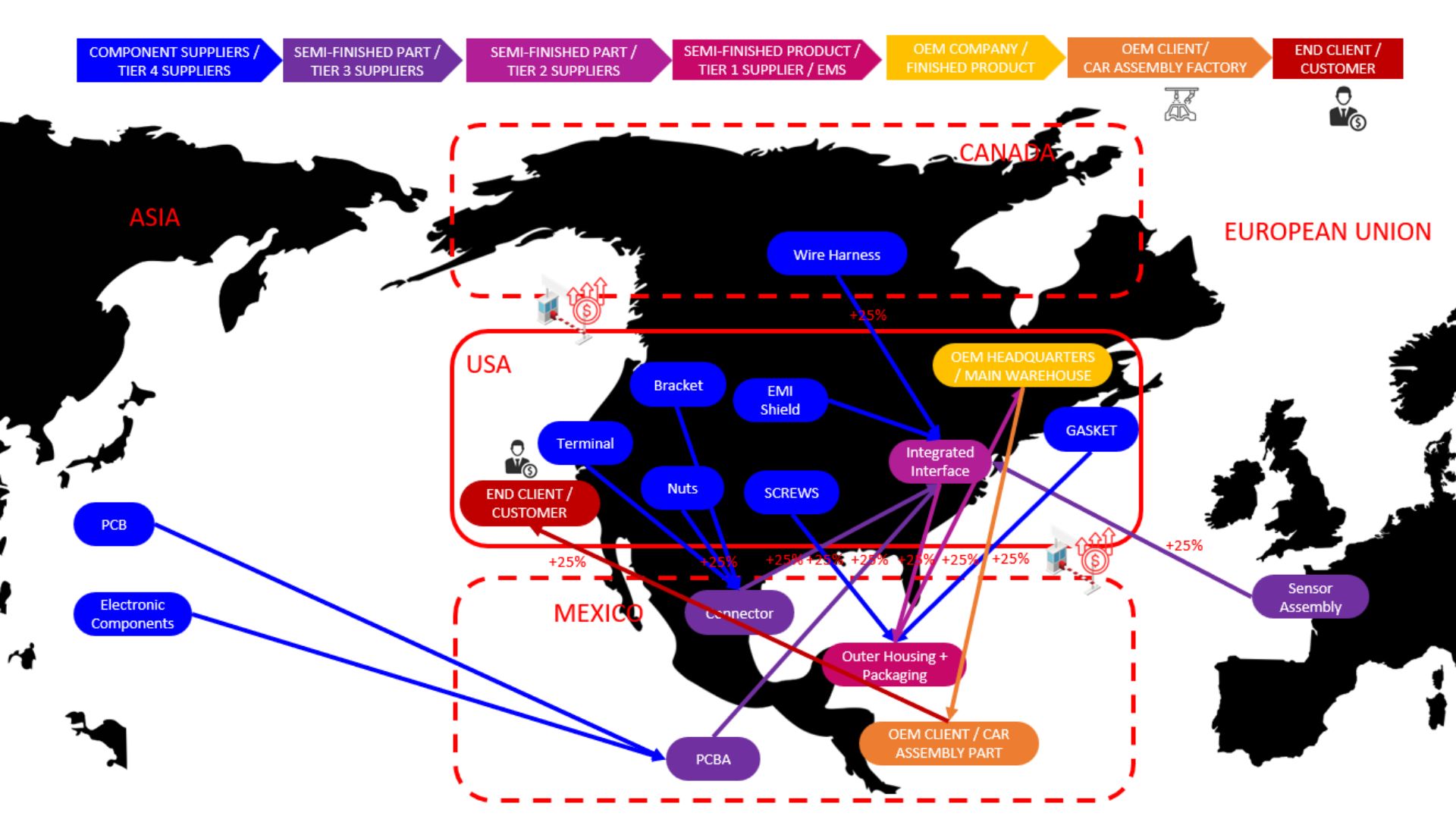
- New US tariffs and the USMCA framework can trigger a 25% duty every time a part crosses a border — not just once.
- A modern automobile is built from ~30,000 parts; the more times each one moves between countries, the harder tariffs hit the bill of materials.
- Supply chain complexity multiplies tariff chaos. Every additional supplier and border crossing layers in new tariff, customs and lead-time risk.
- Consolidating plastic injection, metal stamping, overmolding and insert molding under one roof reduces cross-border transactions and tariff exposure.
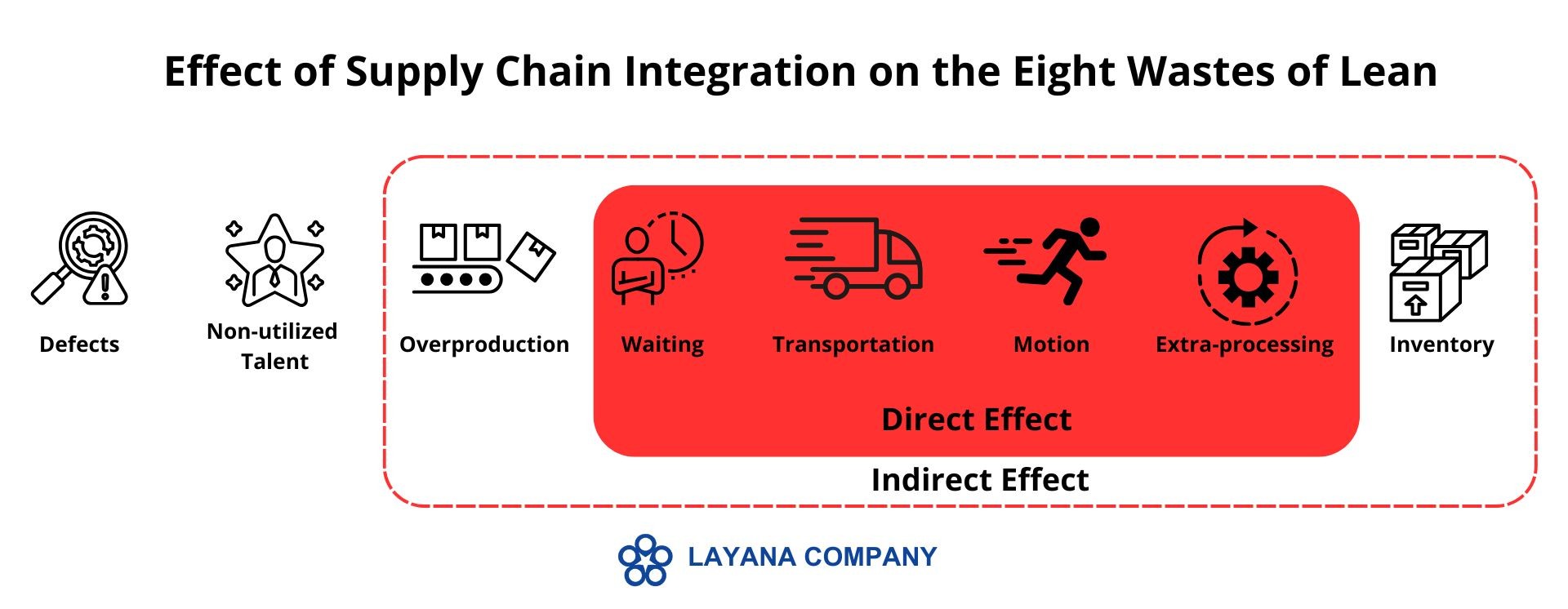
- Supply chain integration directly cuts 4 of the 8 Lean wastes (waiting, transportation, motion, extra processing) and indirectly cuts 2 more.
- Layana Company delivers turnkey, horizontally integrated manufacturing — engineering, tooling, mass production, automation and assembly on a single site.
New US Tariffs Are Reshaping Global Trade
New US tariffs and trade policies are now in force, adding layers of complexity to cross-border procurement for both American and international companies. Under the USMCA framework, supply chains are intricately linked — a single part may cross the US-MX or US-CA border several times, and each crossing can attract its own duty rather than the one-shot tariff most managers plan for.
These measures have significantly eroded competitiveness in both the domestic market and globally. Consider the modern automobile: it comprises roughly 30,000 individual parts sourced from various countries, with unfinished and partially assembled components frequently shuttling between plants. In times of heightened uncertainty, simplifying the supply chain — whether by reducing the number of suppliers or streamlining manufacturing processes — significantly enhances resilience.
Advanced techniques such as overmolding, insert molding, and integrated bi-material (metal + plastic) technologies — pioneered by companies like Layana — optimize supply chains, improve operational speed and security, and reduce the risk of incurring multiple tariffs at customs.
Supply Chain Complexity as a Tariff Chaos Magnifier
Supply chain complexity and a lack of process integration significantly amplify the chaos induced by tariffs. When a supply chain depends on a multitude of suppliers to deliver separate components for intermediate or final assembly, each supplier interaction introduces another layer of risk. Every time parts cross international borders, the door opens to unexpected tariffs, customs delays and regulatory complications — a multiplicative effect that inflates cost and stretches lead times.
Atomized vs. integrated — same product, very different exposure
Many suppliers, many borders, many tariffs
- Connectors, terminal pins and brackets sourced from different vendors in different countries.
- Each semi-finished part can incur a fresh duty every time it crosses a border on its way to the next operation.
- Customs delays, paperwork errors and regulatory mismatches compound at every hand-off.
- Looks cheap when trade is open and stable; collapses the moment tariff or trade-policy volatility hits.
One supplier, one roof, one transaction
- Plastic injection and metal stamping share a single quality system and engineering team.
- Components are combined into a semi-finished module before they ever cross a border.
- Fewer suppliers, fewer customs entries — multi-tariff exposure collapses toward a single duty event.
- Lead times shorten and the OEM can absorb tariff or policy shocks without redesigning the BOM.
A more integrated approach mitigates these risks. By consolidating various manufacturing techniques under a single service provider — one that offers full engineering capabilities, comprehensive quality assurance and semi-finished goods ready for rapid, modular assembly — companies can reduce the number of cross-border transactions. This streamlined process minimizes exposure to tariff fluctuations and customs controls, fostering a more resilient and agile production system.
For companies operating in cross-border environments, particularly in regions where trade policies are volatile, rethinking supply chain structure is now strategic, not tactical. Instead of maintaining an atomized network of suppliers, OEMs should explore partnerships with horizontally integrated manufacturers that can manage multiple production stages under one roof — lowering logistical complexity, the risk of shortages and the impact of sudden tariff hikes.
Logistics Optimization Through Integrated Supply Chains
One illustrative example of an integrated supply chain is partnering with suppliers that consolidate multiple material technologies on a single site. A manufacturer running plastic injection and metal stamping under the same roof eliminates the OEM's need to source connectors, terminal pins and brackets for overmolded sensors from multiple vendors and countries.
Consider a sensor intended for use in an automotive throttle module. By obtaining all components from a single, integrated supplier, the OEM achieves fast, secure and efficient modular assembly of the complete interface — terminals, brackets, plastic body and overmold all originating from one quality system, one engineering team and one customs entry.
By contrast, sourcing each sensor component from different suppliers ratchets up supply chain complexity. Even when these fragmented solutions appear cost-effective during periods of trade openness and economic stability, they exemplify an inefficient supply chain lacking both supply-chain and industrial-process integration. Under tariff stress, the cost impact is severe, and operational risk remains consistently high throughout the product's life cycle.
Building lean supply chains through robust risk mitigation is essential for safeguarding competitiveness — especially in industries as dynamic as automotive and electronics. Integration directly eliminates four of the eight wastes of Lean, and indirectly reduces two more.
Engineering & DFM — design-for-manufacturing review, tolerancing, mold-flow and tool concept on day one.
Tooling workshop — in-house progressive/transfer dies and overmolding tools, faster iteration, no IP hand-off.
Bi-material processing — plastic injection + metal stamping + overmolding + insert molding in the same plant.
Automation & assembly — proprietary automation team scales the module from pilot to mass production.
Case Study — A Throttle-Module Sensor
The same sensor sourced two ways. The difference shows up in lead time, tariff exposure and quality risk.
Connectors, pins and brackets sourced separately
The OEM places four POs with four suppliers in three countries. Each shipment carries customs paperwork; each leg adds duty risk.
Risk: a single tariff change forces re-routing or BOM-level pricing renegotiation across the whole supplier set.
Sub-assembly at a 5th vendor
Components are shipped to a sub-assembler that overmolds the terminals into the plastic housing. The semi-finished module crosses another border on the way to the OEM.
Risk: the part now incurs tariffs at this crossing, on top of duties already paid further upstream.
Stamped terminals + plastic body — same plant
Layana stamps copper terminals and contact pins in-house, then transfers them straight to the overmolding cell — no border, no carrier, no customs.
Outcome: the OEM receives a finished modular sensor ready for the throttle-module assembly line.
One shipment, one customs entry
The completed module ships once. The OEM controls one PO, one quality dossier and one set of customs paperwork instead of five.
Outcome: tariff exposure collapses, lead time shortens, and Lean waste in transportation and waiting is eliminated.
Even when fragmented solutions look cost-effective in open-trade conditions, they expose the OEM to the full force of every new tariff. Integration is not a cost-saving tactic — it is a strategic hedge against trade volatility.
The Eight Wastes of Lean — and How Supply Chain Integration Reduces Them
Integrated and simplified supply chains optimize logistics efficiency by directly eliminating four of the eight wastes of Lean, and indirectly reducing two additional wastes. Hover or tap any card to see the impact level.
Waiting
Idle time between supplier hand-offs disappears when stamping, molding and assembly run on one site — no inter-vendor logistics queue.
Transportation
Components do not ship between vendors and countries before assembly — fewer trucks, fewer customs entries, fewer tariff events.
Motion
Material handling shrinks to internal transfers on the same shop floor, eliminating warehouse-to-warehouse movement of semi-finished parts.
Extra Processing
Duplicate inspection, re-packing and re-qualification at every vendor are replaced by one continuous quality system end-to-end.
Inventory
Shorter lead times and tighter scheduling reduce buffer stock between processes, freeing working capital.
Defects
A single quality system and integrated DFM lower the probability that a defect escapes between vendor boundaries.
Overproduction
Governed by forecasting and pull signals — not directly addressed by structural integration, though shorter cycle times help.
Non-utilized Talent
An organizational, not logistical, waste — addressed through engineering culture and continuous-improvement programs.
Layana Company — A Turnkey Manufacturing Solution
Layana stands out as a comprehensive partner for OEMs navigating today's volatile trade environment. A broad spectrum of manufacturing processes — advanced plastic injection and metal stamping, overmolding, insert molding — runs alongside a seasoned tooling team and an in-house automation group, simplifying the supply value chain. The result: fewer suppliers, fewer cross-border transactions, and a meaningful reduction in multi-tariff risk.
Plastic Injection
Engineering thermoplastics, precision tolerances, multi-cavity tooling for high-volume parts.
Metal Stamping
Progressive- and transfer-die stamping for terminals, brackets, baseplates and busbars.
Overmolding
Encapsulating metal inserts in plastic for sealed, integrated bi-material parts.
Insert Molding
Embedding stamped or machined inserts during injection for one-shot, ready-to-assemble modules.
Tooling Fabrication
In-house mold and die makers — faster iteration cycles and zero IP transfer to third parties.
Automation
Proprietary automation cells designed for each program — pilot to mass production with consistent yield.
Modular Assembly
Vertical integration: parts ship as ready-to-fit modules for OEMs or EMS providers.
Quality Assurance
IATF 16949–certified processes, DFM support, traceability and one consolidated quality dossier.
Why this matters under the 2025 tariff regime
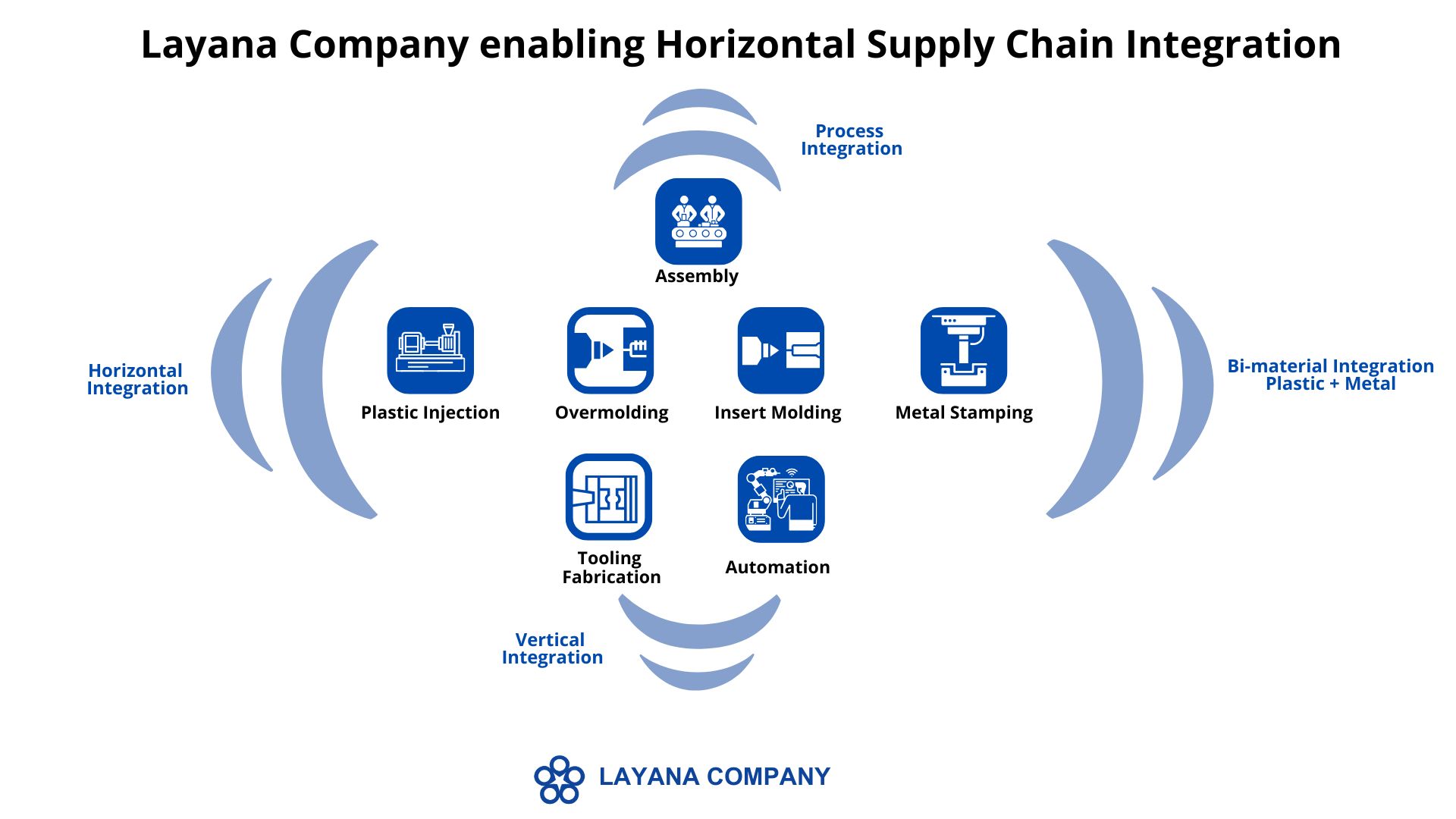
Whether the OEM is producing automotive sensors, electronic components, or other high-precision parts for the biking, consumer, aerospace or medical industries, Layana's uniquely integrated services create lean supply chains that are more resilient against market fluctuations, tariff policies and overall trade-policy changes. By consolidating operations under one roof, the OEM significantly reduces delays, transportation inefficiencies, additional logistics cost and the burden of double, triple or even multiple taxation on the same component — in an environment of high tariff pressure and uncertainty.