Layana — Sensor & Transducer Components
Transducer Housing: Reliable OEM Sensor Assemblies
A transducer housing has to do more than cover a sensor. It must protect the sensing element, hold terminals in exact position, insulate and seal the electrical interface, and preserve the acoustic, optical, pressure, or thermal path the device depends on. Layana engineers and manufactures these housings as complete metal-plastic systems — stamping, insert molding, overmolding, assembly, and inspection under one controlled production system.
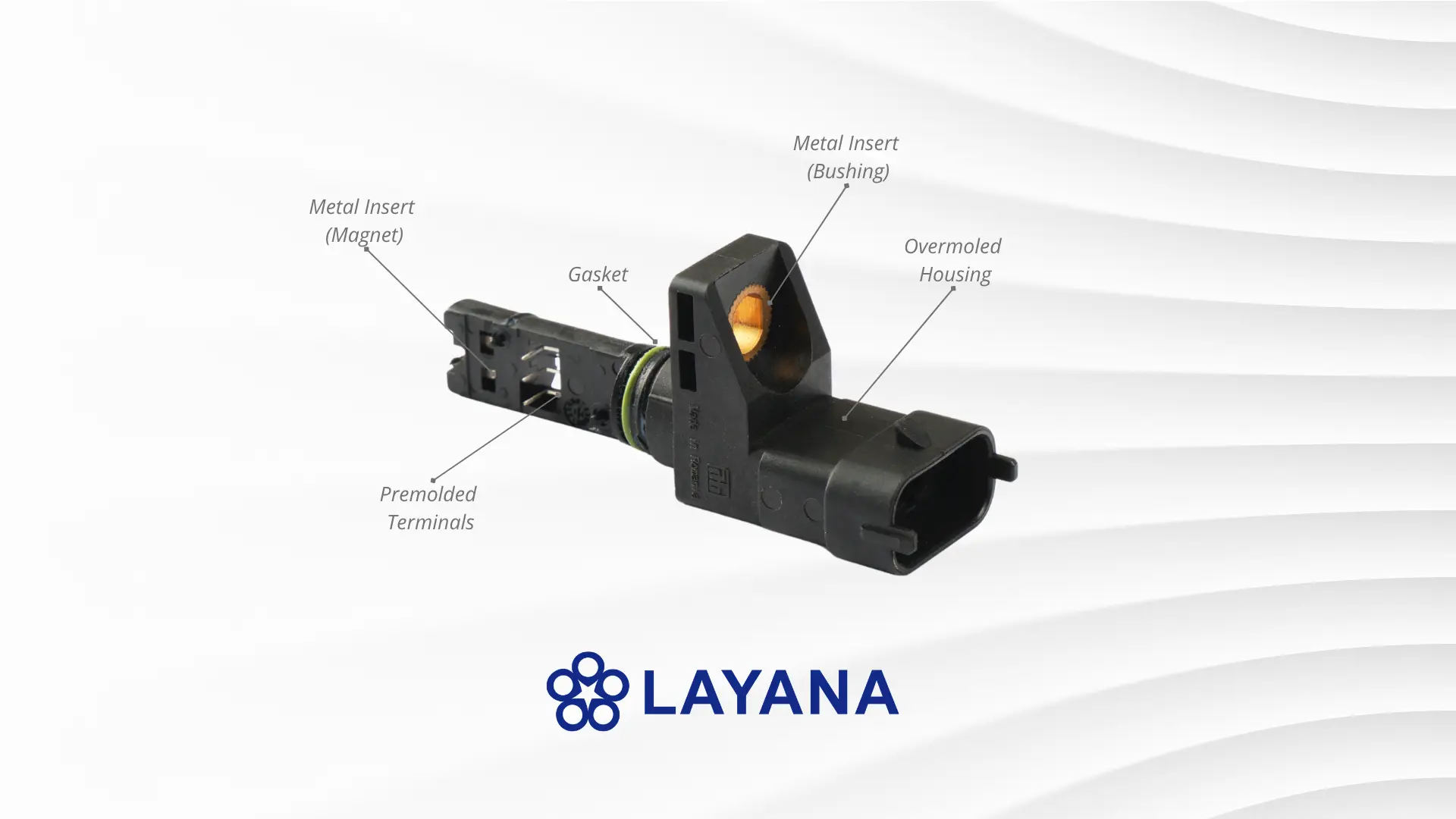
A transducer housing is the engineered enclosure that protects, locates, seals, and connects a transducer while preserving signal performance in the operating environment.
It is normally an injection-molded body — often with insert-molded metal terminals or a stamped leadframe — selected and shaped around one operating environment: temperature, chemicals, humidity, vibration, electrical stress, and the sensing interface itself.
Navigation Jump to a Section
What Layana Can Do
Layana's Integrated Manufacturing Advantage
Have a transducer housing project that requires tight control over sensing stability, electrical connectivity, sealing performance, and controlled assembly process?
Layana is an IATF 16949-certified manufacturer based in Lukang, Taiwan, specializing in precision plastic injection molding, metal stamping, overmolding, and high-accuracy assembly. We apply our manufacturing experience to support OEMs with reliable transducer housing solutions for sensing systems used in high-reliability and performance-critical industries.
Layana consolidates every critical manufacturing stage under one controlled production system. This integrated approach reduces cross-process variability, strengthens dimensional and positional control, and improves overall stability during mass production. The result is more stable sensor performance, fewer interface-related failures, and higher long-term reliability in demanding operating environments.
Layana's engineering team can review your drawings, interface requirements, material selection, tolerances, and annual production volume to evaluate manufacturability and identify potential risks early in the design cycle. We support early-stage DFM collaboration and RFQ review to help customers move from concept to production with clearer technical direction and minimized manufacturing risk.
Definition
What Is a Transducer Housing?
A transducer housing is a structural enclosure or molded body designed around a sensing or energy-conversion element. Depending on the product, the housing may contain a piezoelectric element, terminals, leadframes, busbars, ICs, connectors, coils, seals, lenses, acoustic windows, or mounting features. In many automotive, electronics, IoT, medical, industrial, and power applications, the housing must combine several functions at once:
- Protect the sensing element and electronics from dust, humidity, chemicals, vibration, impact, and temperature cycling.
- Maintain exact positioning of terminals, pins, contacts, and sensing elements so that signal output remains stable.
- Provide electrical insulation, dielectric spacing, creepage and clearance control, and strain relief.
- Support acoustic, optical, pressure, or thermal transfer when the transducer must interact with the outside environment.
- Enable fast assembly into a larger module, connector, vehicle system, medical device, or industrial machine.
In an ultrasonic or acoustic transducer, for example, housing design must avoid unintentionally damping the useful signal path while still protecting the element from mechanical and environmental damage. Acoustic impedance matching is a known design challenge for piezoelectric transducers because mismatch can reduce energy transfer, increase signal distortion, and reduce signal-to-noise performance (Sahu et al., 2020).
This does not mean every plastic housing is an acoustic matching layer. It means that the housing, matching layer, backing, adhesive, potting, and interface geometry should be considered as one system when the device depends on acoustic performance.
Engineering Mechanisms
How Transducer Housing Works
A well-designed transducer housing works through four engineering mechanisms: protection, positioning, connection, and controlled interface.
Protection
The housing forms the first barrier against dust, water, oil, chemical exposure, abrasion, and impact. For electrical and electronic equipment, ingress protection is commonly discussed through IP ratings under IEC 60529, which classifies enclosure protection against solid objects and liquids.
Positioning
The housing fixes the sensor, transducer element, connector pins, and stamped terminals in the correct location. This is critical for repeatability because small shifts can affect electrical connection, acoustic coupling, optical alignment, or mechanical preload.
Connection
The housing can integrate terminals, leadframes, threaded inserts, connector structures, busbars, or grounding and shielding elements. Insert molding is useful because thermoplastic can encapsulate metal stampings to combine structural support, environmental protection, and embedded interconnect functionality in one part (Interplex, 2015).
Controlled Interface
The housing defines how the transducer interacts with the external medium. Depending on the application, this may mean an acoustic window, pressure port, light path, flexible membrane, thermal path, gasket land, or connector seal.
Anatomy
Typical Transducer Housing Structure
A typical structure may include several functional zones. The exact geometry changes by application, but the engineering logic is similar: protect the sensing element, control the signal path, locate the electrical connection, and seal the interface.
| Functional zone | What it contains and controls |
|---|---|
| External interface | Acoustic window, pressure port, optical path, membrane, or exposed sensing interface. |
| Housing body | Engineered resin body with ribs, bosses, datum surfaces, seal lands, and mounting features. |
| Connector / cable exit | Stamped terminals, leadframe, pins, cable strain relief, or connector cavity. |
| Sealing / protection zone | Gasket groove, overmolded elastomer, weld joint, vent membrane, or potting boundary. |
| Sensing element zone | Piezo element, sensor chip, coil, magnet, or other sensing component positioned against a controlled datum. |
| Metal-plastic interface | Insert-molded or overmolded terminals supported by tooling, resin flow control, and inspection datums. |
Process Rationale
Why Transducer Housings Benefit from Integrated Molding
Integrated molding can combine multiple materials or components into a single finished part.
For transducer housings, this approach may support:
- More consistent assembly
- Reliable overall performance
The most suitable manufacturing method depends on the product design, application requirements, and production volume.
- More components
- Additional assembly steps
- Greater design complexity
- More potential points of variation
Materials
Material Selection: Matching the Housing to the Environment
Material selection should begin with the operating environment, not with the easiest resin to mold. Transducer housings may face under-hood heat, UV exposure, fuels or cleaning chemicals, humidity, salt spray, vibration, sterilization, impact, or continuous electrical stress. The material must also flow into thin walls, fill around inserts without voids, hold tolerances after cooling, and maintain performance over the product lifetime.
Common engineering plastics for transducer and sensor housings include PBT, PPS, PA6/PA66 or glass-filled nylon, PC, PC/ABS, POM, LCP, PEEK, PSU, PEI, TPU, TPE, and LSR depending on application requirements.
Typical Housing Material Choices
| Material family | Useful properties | Typical housing role | Key design cautions |
|---|---|---|---|
| PBT / reinforced PBT | Dimensional stability, electrical insulation, good moldability | Connector bodies, power module housings, sensor housings | Hydrolysis and long-term heat exposure must be checked for the exact grade. |
| PA6 / PA66 / GF-PA | Strength, toughness, heat resistance, good structural performance | Automotive housings, brackets, reinforced transducer bodies | Moisture absorption affects dimensions; glass orientation can influence warpage. |
| PPS / PPA / LCP | High-temperature performance, chemical resistance, precision molding | Harsh-environment electronics, compact terminals, high-temp sensors | Processing window, tooling, and cost require experienced molding control. |
| PC / PC-ABS | Impact resistance, dimensional stability, good appearance | Electronic enclosures, covers, protected indoor housings | Chemical stress cracking and flame rating must be validated. |
| TPU / TPE / LSR | Flexibility, sealing, damping, soft interface | Strain relief, waterproof seals, cable overmolds, gaskets | Bonding compatibility with substrate is critical to prevent delamination. |
| PEEK / PEI / PSU | High performance, heat resistance, medical/industrial suitability | Specialty medical, aerospace, and high-temperature micro components | Higher material and processing cost; not needed for every application. |
For electrical applications, flammability requirements must also be addressed. UL 94 covers tests for polymeric materials used in parts in devices and appliances and is commonly used as a material preselection reference for enclosure and electronic component design (UL Standards & Engagement, 2026).
Risk Review
Common Failure Modes in Transducer Housing
Most transducer housing failures trace back to the metal-plastic interface, the sealing strategy, or resin behaviour during and after molding. These are the modes worth reviewing before tool build.
The best prevention is early cross-functional review between product design, tooling, stamping, molding, quality, and assembly teams. In transducer housing, the most expensive problems are often created before steel is cut.
Layana's engineering team reviews manufacturability before tool build, coordinating stamped insert design with mold design, validating insert positioning and sealing features, and using inspection feedback to stabilize production and minimize deviations.
Industries Served
Applications of Transducer Housing
Transducer housings appear wherever a sensing or energy-conversion element must operate reliably in a real environment. Typical applications include:
Automotive & EV
ADAS sensors, lighting systems, current sensors, pressure sensors, connector-integrated transducers, charging systems, and power electronics modules.
Industrial Automation
Proximity sensors, ultrasonic sensors, flow meters, load cells, vibration sensors, and machine monitoring devices.
Medical & Healthcare
Diagnostic sensors, microfluidic systems, drug-delivery devices, ultrasound-related components, and single-use sensor assemblies.
Consumer Electronics & IoT
Wearables, smart locks, smart appliances, compact microphones, environmental sensors, and connected device modules.
Aerospace & Defense
Sealed sensor modules, lightweight connectors, avionics components, fluid-management sensors, and high-reliability miniature parts.
Power & Energy
Power electronics housings with embedded busbars and leadframes, where insulation, creepage control, and thermal management govern the design.
Supplier Strategy
Why an Integrated Metal-Plastic Manufacturer Matters
A transducer housing often sits at the boundary between precision metalworking and precision plastic molding. Terminals, leadframes, and busbars require stamping expertise. Encapsulation, sealing, insulation, and geometry require molding expertise. The final assembly requires inspection and process control. When these capabilities are separated across suppliers, engineering changes can move slowly and quality responsibility can become fragmented.
An integrated metal-plastic manufacturing partner can co-design the metal insert and plastic interface together. This improves control of terminal position, resin flow, bonding geometry, strain relief, and inspection features. For OEM customers, the value is not only fewer parts or fewer suppliers; it is a more controlled development path from stamped insert design to mass production.
Layana's in-house capabilities across progressive die stamping, insert molding, overmolding, tooling, automation, inspection, and assembly are built around this integrated model, with documented process controls and metrology suited to automotive, electronics, medical, industrial, and power applications.
Layana Parts
Transducer Housing Assembly
Components Layana manufactures for automotive transducer and sensor assemblies. Each part combines a stamped metal element with an engineered thermoplastic body, produced in-house through progressive stamping and insert molding.
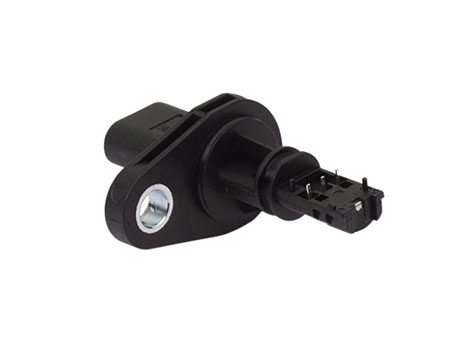
Sensor
- Industry
- Automobile
- Material
- PA66+30%
- Color
- Black
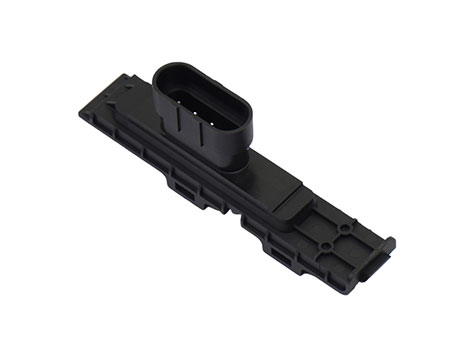
Connector
- Industry
- Automobile
- Material
- PA66+30%+C5191
- Color
- Black
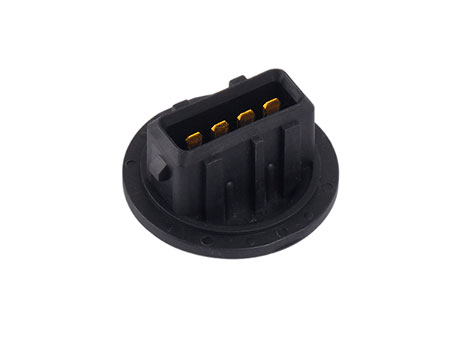
Contacts
- Industry
- Automobile
- Material
- PPA+65%+C2680
- Color
- Black
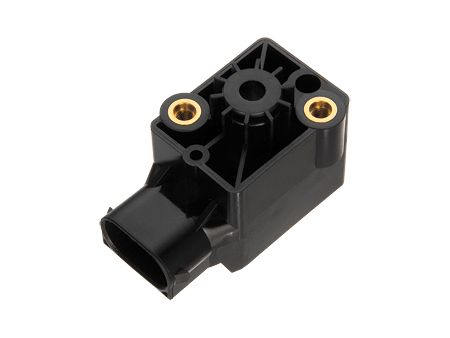
Body-Sensor, Twist-Lock
- Industry
- Automobile
- Material
- PBT, 30%GF
- Color
- Black
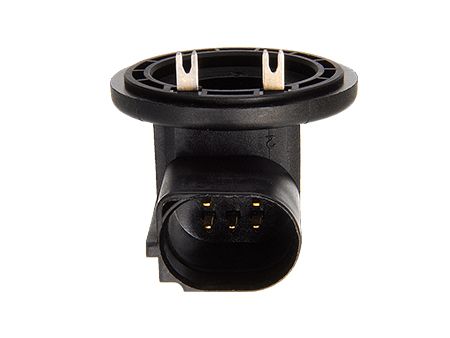
Housing
- Industry
- Automobile
- Material
- PBT, 20% GF
- Color
- Black
Speed & Angle Detection
- Industry
- Automobile
- Material
- Plastic: PA66+30%GF · Pin: C5191
- Color
- Black
Frequently Asked Questions
FAQ — Transducer Housing
Sources & Standards
References
- International Electrotechnical Commission. Ingress protection (IP) ratings. https://www.iec.ch/ip-ratings
- Interplex. (2015). Integration of insert molding processes to optimize production of plastic modules for electronics, sensors and medical applications [Technical bulletin].
- Sahu, B., Dvivedi, A., & Sharma, P. K. (2020). A review of acoustic impedance matching techniques for piezoelectric sensors and transducers. Sensors, 20(14), 4051. https://doi.org/10.3390/s20144051
- UL Standards & Engagement. UL 94: Tests for flammability of plastic materials for parts in devices and appliances.
- Zhou, Q., et al. (2017). Broadband gradient impedance matching using an acoustic metamaterial for ultrasonic transducers. Scientific Reports, 7, 42863. https://doi.org/10.1038/srep42863