Quality for All — How Layana Built a TQM Culture with 10+ Certified Quality Technicians
During the COVID-19 quarantine, when most companies pressed pause, Layana invested the time in continuous improvement. We engaged a quality professor to lead more than 50 hours of in-house training, and earned more than 10 Certified Quality Technicians (CQT) — accredited by the Chinese Society for Quality (CSQ) and the American Society for Quality (ASQ). This is how a quality philosophy becomes a measurable, certified culture.
A People-First Quality Culture, Audited Across Every Process
Layana is an IATF 16949 certified manufacturer in Lukang, Taiwan, with 40+ years of precision metal stamping, plastic injection, overmolding and automation experience. Behind every audited process is a deeper commitment: Total Quality Management (TQM), owned by every employee — not policed by a department. "Quality for All" is what that commitment looks like in practice.
- 10+ ASQ & CSQ Certified Quality Technicians across the shop floor
- 50+ hours of in-house TQM & CQT training delivered weekly across a year
- Anchored to IATF 16949, Six Sigma, SPC, PPAP, FMEA and PFMEA
- Trusted across EV, automotive, aerospace and electronics supply chains
Key Takeaways
- Total Quality Management (TQM) is an organization-wide strategy for continuously improving performance at every level and in every area of responsibility.
- It combines fundamental management techniques, ongoing improvement efforts and specialized technical tools under one disciplined structure focused on satisfying cost, quality, schedule and customer need.
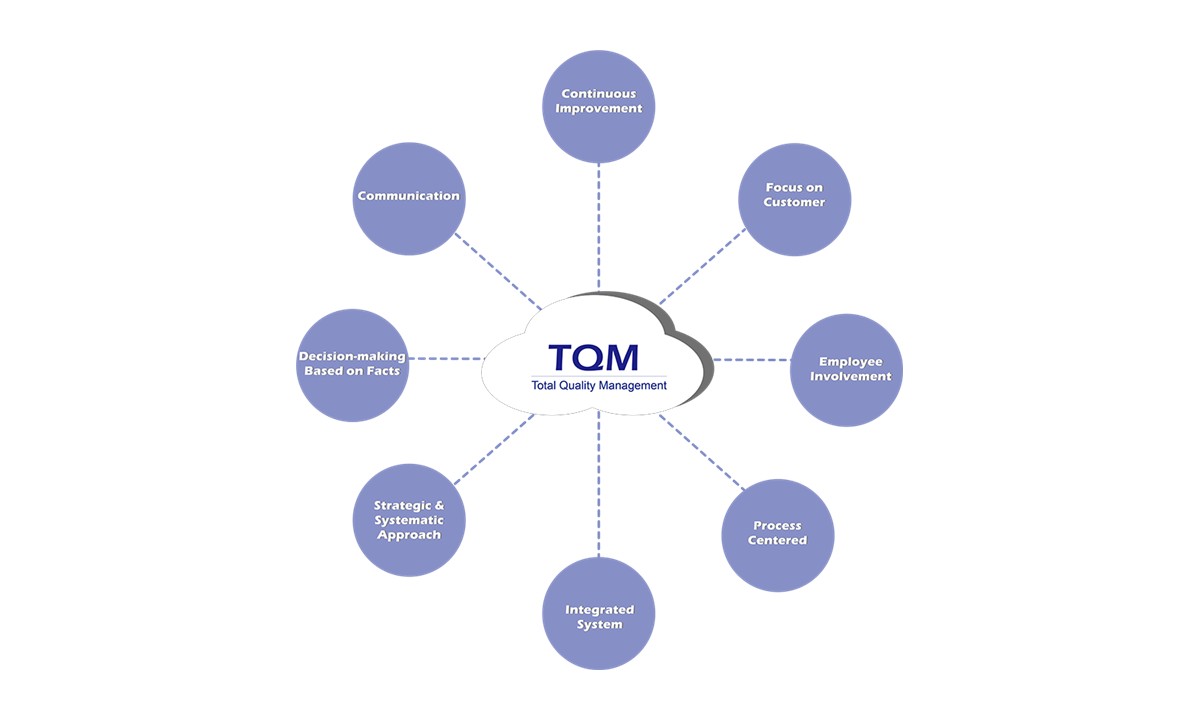
- TQM rests on 8 core principles: customer focus, total employee involvement, process-centered thinking, an integrated system, a strategic & systematic approach, continuous improvement, fact-based decision making, and communication.
- During the COVID-19 quarantine period, Layana ran a weekly in-house CQT course of 50+ hours, taught by a quality professor — turning enforced downtime into measurable training capacity.
- The result: 10+ Certified Quality Technicians at Layana, accredited by the Chinese Society for Quality (CSQ) and the American Society for Quality (ASQ) — a tangible step toward our ultimate goal, Quality for All.
Navigation Jump to a Section
What Is Total Quality Management (TQM)?
Total Quality Management is not a tool or a department — it is a company-wide management philosophy for continuously improving performance everywhere work happens.
In the U.S. Department of Defense's foundational 1988 definition, TQM is "a strategy for continuously improving performance at every level, and in all areas of responsibility." It combines fundamental management techniques, existing improvement efforts and specialized technical tools under one disciplined structure aimed at continuously improving all processes.
Improved performance is directed at satisfying broad goals such as cost, quality, schedule, and mission need and suitability — with increasing user satisfaction as the overriding objective. TQM builds on the pioneering work of Dr. W. Edwards Deming, Dr. Joseph M. Juran and others, and draws on private- and public-sector experience with continuous process improvement.
The 8 Core Principles of TQM
Across the literature, TQM is held up by eight interlocking principles. Each one is a habit of practice — not a checkbox — and together they form the culture Layana works to live by.
Customer Focus
The customer ultimately defines the level of quality. Every product, process and improvement is judged on whether it raises customer satisfaction.
Employee Involvement
Total employee involvement means everyone — from operator to executive — works toward common goals, supported by an environment of empowerment, training and trust.
Process Centered
A process turns inputs into outputs for customers, internal or external. Define the steps, measure them, monitor them — that is how variation gets controlled.
Integrated System
Vertical functions, horizontal processes and supply-chain partners are connected into one system — so improvements in one area flow to the others, not against them.
Strategic & Systematic
A strategic plan including quality as a core component — disciplined, documented and reviewed — keeps improvement aligned with the company's vision and mission.
Continual Improvement
PDCA — Plan, Do, Check, Act — never stops. Small, steady gains across every process compound into a competitive advantage no single project can deliver.
Decisions on Facts
Data, not opinion, drives decisions. Statistical process control, MSA, PPAP and root-cause analysis make the truth visible — and improvement repeatable.
Communication
During every change — strategy, method, daily operations — effective communication keeps morale, motivation and alignment intact across the whole organization.
TQM, Visualized — One Core, Eight Spokes
Hover any node to see the principle highlight. The eight elements are not a hierarchy — they are mutually reinforcing spokes around a single goal.
A reinterpretation of the classic TQM model — the eight principles all serve a single overriding objective: customer satisfaction.
Layana's Take on TQM — Decades of Quality Discipline
Layana has applied TQM in-house for decades. We do not separate quality from operations — every process, every employee, every supplier sits inside one quality system.
That conviction is what makes our IATF 16949 certification meaningful instead of ceremonial. The audit is the floor, not the ceiling. Our Quality Control Circles (QCC) identify problems and pilot fixes from the bottom up. Our Six Sigma belts attack variation with statistics. Our internal training programs keep teams fluent across SPC, MSA, FMEA, APQP and PPAP. TQM is the umbrella that links all of it.
When COVID-19 reduced normal business interactions, we treated quarantine not as a pause but as uninterrupted improvement time. We could either lose a year — or use it to deepen the bench. We chose the second.
"During Covid-19, there were fewer interactions between most businesses. Layana took advantage of the quarantine period — because Layana must be continuously improving all processes."
— A principle, not a sloganThe CQT Training Program — 50+ Hours, Weekly, Across a Year
We engaged a quality professor to deliver a structured Certified Quality Technician (CQT) curriculum to a cross-functional Layana cohort — three hours every week, for a full year.
Engage the Right Instructor
A quality professor with industry depth was brought in to design and lead the program — using the official ASQ / CSQ CQT body of knowledge as the curriculum spine.
Three Hours, Every Week
A standing weekly slot during the quarantine year kept momentum even when production schedules flexed — no skips, no rescheduling away the discipline.
Cross-Functional Cohort
Operators, inspectors, engineers and supervisors learned side-by-side — so SPC, MSA, calibration and sampling were spoken as one shared language afterward.
50+ Hours of Content
The curriculum covered quality concepts, inspection planning, statistical methods, metrology, calibration, sampling plans, training and procedural writing.
Examination & Certification
Candidates sat the certification examination accredited by CSQ and ASQ, validating each individual against an internationally recognized standard.
Knowledge Multiplier
Each certified technician now becomes an in-house coach — every shift carries multiple people who can run an MSA study, defend an SPC chart or audit a sampling plan.
Results — 10+ Certified Quality Technicians, On Staff Today
When the certification results arrived earlier this year, the whole team was over the moon. The headline numbers:
It is not just a credential count — it is a shift in how problems are diagnosed on the shop floor. When an inspector sees a control chart trending up, the conversation that follows is already in the same language as the engineering response. When a customer asks for a PPAP submission, multiple people can run the package end-to-end. When a new product launches, the FMEA review pulls in trained voices from every step of the process.
That is what "Quality for All" buys you — and exactly why we will keep going. The 10+ figure is a milestone, not a finish line.
The Certifying Bodies — CSQ & ASQ
Our CQT cohort was certified jointly by two of the world's most respected quality societies. Their accreditation is recognized across the global automotive and electronics supply chains.
American Society for Quality (ASQ)
ASQ is the global authority on quality — issuing recognized certifications including the Certified Quality Technician (CQT), Certified Quality Engineer (CQE), Six Sigma Black Belt, Master Black Belt and more. Its body of knowledge is a standard reference across automotive, aerospace and electronics manufacturing.
Chinese Society for Quality (CSQ)
The Chinese Society for Quality, founded in Taiwan in 1964, is the regional quality authority — running the local CQT examination jointly recognized with ASQ. CSQ certification signals proficiency in quality concepts, statistical methods and inspection practice to Taiwan's manufacturing ecosystem.
Quality for All — The Goal Is Already the Practice
We gained much confidence by getting one step closer to true TQM. The next 10 certifications are already in planning. Quality for All means more than a slogan — it means every team carries someone who can read a control chart, defend a sampling plan, or open the right corrective-action conversation.
That is the long compounding bet behind TQM: when quality is owned by every employee, the certifications you can hang on the wall — IATF 16949, ISO 14001, ISO 45001 — stop being framed credentials and start being honest summaries of how the company actually runs.
If you are sourcing precision metal-stamping, plastic injection or bi-material components, talk to us. Our quality team will walk you through the system, the people behind it, and how it shows up in your part.
"TQM comes from good working attitude and character."
— A slogan deeply rooted in Layana's DNA
Frequently Asked Questions about TQM & CQT
Total Quality Management (TQM) is an organization-wide strategy for continuously improving performance at every level and in every area of responsibility. It combines fundamental management techniques, existing improvement efforts and specialized technical tools under a disciplined structure focused on continuously improving all processes. The goal is to satisfy broad objectives such as cost, quality, schedule and mission need, with increasing customer satisfaction as the overriding objective. TQM builds on the work of Dr. W. Edwards Deming, Dr. Joseph M. Juran and others, and was formalized by the U.S. Department of Defense in its 1988 Total Quality Management Master Plan.
The eight commonly cited principles of Total Quality Management are: (1) Customer focus, (2) Total employee involvement, (3) Process-centered thinking, (4) Integrated system, (5) Strategic and systematic approach, (6) Continual improvement, (7) Fact-based decision making, and (8) Communication. Together they describe a quality-as-culture model in which every employee, process and decision contributes to satisfying the customer.
A Certified Quality Technician (CQT) is a quality professional who, in support of and under the direction of quality engineers or supervisors, analyzes and solves quality problems, participates in quality improvement projects, prepares inspection plans and instructions, selects sampling plans, applies metrology, calibration and statistical methods, prepares procedures and trains inspectors. The CQT is a recognized certification issued by the American Society for Quality (ASQ) and is accredited locally in Taiwan by the Chinese Society for Quality (CSQ).
During the COVID-19 quarantine period, when normal business interactions were reduced, Layana invested the time in continuous improvement by engaging a quality professor to teach an in-house CQT course of over 50 hours — three hours every week throughout the year. The result, announced earlier this year, is that more than 10 Layana employees are now Certified Quality Technicians, jointly accredited by the Chinese Society for Quality and the American Society for Quality.
Layana operates an IATF 16949 automotive quality management system and believes quality is engineered in, not inspected in. Building a deep bench of certified quality technicians spreads quality expertise across the shop floor — every operator, inspector and engineer shares the same vocabulary for statistical process control, measurement system analysis and continuous improvement. That is what "Quality for All" means in practice: TQM as a culture, owned by every employee, not a department.
TQM is the umbrella culture; the others are the operating tools. IATF 16949 supplies the audited automotive quality management system. The five core tools (APQP, PFMEA, MSA, PPAP, SPC) operationalize defect prevention. Six Sigma's DMAIC and DMADV methodologies attack variation with data. Quality Control Circles (QCC) push improvement into cross-functional teams on the shop floor. Layana's training program keeps all of it fluent across the organization.