ISO 14064-1
Greenhouse Gas Inventory & Verification
ISO 14064-1 is the world's reference standard for organisation-level greenhouse gas accounting — the quantification, monitoring, reporting and third-party verification of every tonne of CO2-equivalent a company emits. Here is what the standard requires, the five reporting principles and five-step inventory structure, and how Layana's externally audited GHG inventory is built.

Navigation Jump to a Section
Key Takeaways
- ISO 14064-1 is the international standard for measuring, monitoring, reporting and verifying an organisation's greenhouse gas (GHG) emissions and removals — the technical foundation for credible carbon accounting.
- The standard rests on five reporting principles — Relevance, Completeness, Consistency, Accuracy and Transparency — and a 5-step inventory structure that runs from boundary-setting to a verified, public report.
- Layana has successfully completed ISO 14064-1 audit certification, verified internally and externally; the most recent external audit took place on 11 January 2024.
- Layana uses baseline year 2022 and recalculates the baseline whenever boundary changes, methodology changes or error corrections exceed a 3% significance threshold, keeping year-on-year comparisons honest.
- The inventory uses IPCC uncertainty factors for activity data and emission factors, with Global Warming Potential (GWP) coefficients to convert every gas into tonnes of CO2-equivalent.
- ISO 14064-1 supplies the GHG numbers; ISO 14001 turns them into managed reduction action — together they form Layana's path toward carbon neutrality.
What Is ISO 14064?
ISO 14064 is the international family of standards for greenhouse gas (GHG) quantification, monitoring, reporting and verification. Part 1 (ISO 14064-1) sets the principles and requirements at the organisation level — the inventory of a company's emissions and removals. The current revision in force is ISO 14064-1:2018.
By attaining international standards in greenhouse gas inventory, Layana enhances the credibility of its environmental disclosures. Through internal and external verification and certification, the accuracy and reliability of the inventory results are confirmed — every number can be re-traced, re-calculated and stand up to a third-party audit.
Layana has implemented reduction strategies — energy management, equipment-efficiency upgrades, recycling discipline — and these measures are starting to yield results. ISO 14064 is the framework that turns those efforts into auditable evidence, lifting the level of internal control and demonstrating Layana's determination to fulfil its social responsibility toward a carbon-neutral future.
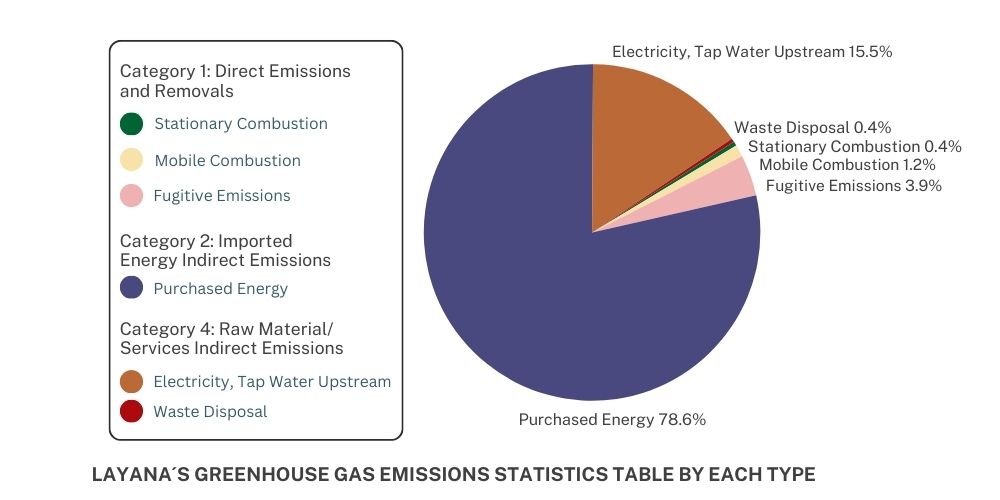
The three parts of ISO 14064, at a glance
| Part | Scope | Use at Layana |
|---|---|---|
| ISO 14064-1 | Specification with guidance at the organisation level for quantification and reporting of GHG emissions and removals. | This is Layana's standard. The company-wide GHG inventory is built and reported under ISO 14064-1:2018. |
| ISO 14064-2 | Specification at the project level for quantification, monitoring and reporting of GHG reductions or removal enhancements. | Reference framework for individual reduction projects undertaken by Layana inside the wider EMS. |
| ISO 14064-3 | Specification with guidance for the verification and validation of GHG statements. | The standard Layana's external auditor follows when verifying the ISO 14064-1 inventory. |
The Five Reporting Principles
Every ISO 14064-1 inventory is built on five reporting principles. Together they ensure that the inventory is credible, reliable and comparable — across reporting years, across business units and across organisations.
Relevance
Identify and report every GHG emission relevant to the organisation — production, energy, transport, waste — direct or indirect, so the inventory mirrors actual operations.
Completeness
Disclose all significant emission sources and scopes, inventorying every applicable gas, so the contribution to climate change is fully visible.
Consistency
Use the same measurement and reporting methods across years and scopes so trends are comparable and improvement is real, not an artefact of methodology change.
Accuracy
Measure, calculate and record each emission source precisely. High data reliability means the company can build reduction strategies on actual conditions, not approximations.
Transparency
Disclose process, methods and results in a way external stakeholders — and auditors — can understand. Transparency is what makes verification possible.
The 5-Step Inventory Structure
ISO 14064-1 prescribes the structure of every organisational inventory — from defining what's in scope to publishing a transparent report. Skip a step and the inventory is not verifiable.
Determine Inventory Scope
Define the organisational boundary — which entities, sites and sources are included. Where shares are held in other companies, emissions are typically apportioned via the control approach.
Establish the Baseline Year
Set a reference (single year, multi-year average or rolling average) for measuring future reductions. Baseline changes must be justified and disclosed.
Identify & Assess Sources
Catalogue every direct and indirect source — purchased electricity, food delivery, customer visits, employee commuting, raw materials, consumer use — to keep the inventory complete.
Maintain Inventory Records
Document methods, activity data, emission factors and calculation steps so every line item can be re-traced and verified.
Publish a Transparent Report
Disclose the inventory process, data and results — both internally and to external stakeholders — clearly enough for third-party assessment.
How Layana Calculates Each Emission Source
For each category of emission source, Layana applies a targeted calculation method consistent with ISO 14064-1 and the IPCC guidelines. Activity data is paired with the appropriate emission factor and, where needed, an IPCC Global Warming Potential (GWP) to convert into tonnes of CO2-equivalent.
| Source category | Example | Calculation method |
|---|---|---|
| Stationary combustion | Kitchen gas, on-site fuel boilers | Carbon emission coefficient method and mass-balance method. fuel × emission factor |
| Mobile combustion | Fuel use in transport equipment | Carbon emission coefficient method. fuel × emission factor |
| Fugitive — septic tanks | On-site sanitary waste | headcount × annual working hours × emission coefficient × GWP |
| Fugitive — refrigerants | HVAC and chillers | Annual fugitive emissions estimated as original equipment fill quantity × annual fugitive rate, converted with GWP. |
| Purchased electricity | Grid power from Taiwan Power Co. | Calculated using the annual carbon emission coefficient published by Taiwan Power Company. |
| Solid & liquid waste disposal | Process waste streams | declared weight × emission coefficient × IPCC GWP |
| Energy resource extraction, manufacturing & processing (upstream) | Embedded emissions in purchased materials | activity data × emission coefficient × IPCC GWP |
The methodology is deliberately repeatable. Anyone — internal auditor, external auditor, customer — can re-walk the same numbers and arrive at the same total.
Baseline Year & IPCC Uncertainty
Two rules keep an ISO 14064-1 inventory honest year after year: a fixed baseline year to anchor reductions, and a disciplined approach to uncertainty in the data itself.
Baseline year — 2022. Layana uses 2022 as its reference inventory year. If a boundary change, a change in quantification method, or an error correction exceeds the 3% significance threshold, the baseline is recalculated and the change is disclosed — so a "reduction" reported next year is a real reduction, not an artefact of restating history.
Uncertainty — IPCC factors. Layana applies the uncertainty factors recommended by the IPCC to both activity data (how much fuel, how many kWh, how many kilometres) and emission factors (how much CO2e per unit). Each source's uncertainty is propagated into an overall figure for the inventory, which sits in the report alongside the totals.
Where ISO 14064 Comes From
ISO 14064 did not appear in isolation — it grew out of three decades of international climate policy. Understanding the lineage explains why the standard insists on verification, transparency and consistency.
Kyoto Protocol
The protocol under the UNFCCC mandates contracting parties to implement specific greenhouse gas emission reduction targets — the first time GHG reductions become a binding international obligation.
UNFCCC Inventory Task Force
The UNFCCC initiates work on GHG inventory and establishes the Inventory Task Force, developing the first version of the Greenhouse Gas Inventory and Reporting Guidelines — the precursor to ISO 14064.
ISO 14064-1 first released
ISO publishes the first edition of ISO 14064-1 — Greenhouse Gas Inventory and Reporting Standard, giving companies a shared technical framework for GHG accounting.
Paris Agreement
The Paris Agreement adopted under the UNFCCC sets the global temperature goal — and accelerates revision of the GHG reporting standards to support it.
ISO 14064-1:2018 — current revision
The latest international specification — the version Layana's inventory is built and audited against — refines boundary-setting, indirect-emission categorisation and verification requirements.
Layana external audit
On 11 January 2024, Layana passes its external audit for ISO 14064-1 — independent third-party verification of the company's organisational GHG inventory.
Layana's Audit & Verification Timeline
The journey from "we should measure our carbon" to a verified ISO 14064-1 inventory runs through a sequence of staged checkpoints. Each stage is auditable in its own right; together they produce a credible carbon disclosure.
Set the Organisational Boundary
Decide what counts as "Layana" for the inventory — entities, sites, ownership — and apply the control approach to investments and joint ventures so every relevant tonne is captured exactly once.
Anchor the Baseline Year (2022)
Lock in 2022 as the reference year, with the 3% significance threshold governing future recalculations — so future "reductions" reflect real performance, not adjusted history.
Quantify Every Emission Source
Apply targeted methods — coefficient, mass-balance, GWP-weighted — to stationary combustion, mobile combustion, fugitive emissions, purchased electricity, waste disposal and upstream materials, including IPCC-recommended uncertainty.
Internal Verification
Cross-functional internal verification of activity data, emission factors and calculation logic — catching errors before the inventory leaves the company.
External Verification — 11 January 2024
Independent third-party audit against ISO 14064-1:2018, applying the verification approach defined in ISO 14064-3 — the certification Layana has now completed.
Continuous Reduction Toward Carbon Neutrality
Layana uses the verified inventory to direct energy management and equipment efficiency upgrades, raising the level of internal control year by year toward the carbon-neutral goal.
Layana's Wider ESG Certifications
ISO 14064-1 supplies Layana's verified greenhouse-gas numbers. It sits inside a broader portfolio that translates those numbers into managed environmental, energy and safety performance.
ISO 14064
Greenhouse gas quantification, monitoring and reporting — the framework on this page.
You are hereISO 14001
Environmental Management System — the PDCA cycle that turns data into action.
ISO 45001
Occupational health & safety management systems.
Carbon Emission Label
Product-level carbon footprint disclosure — fed by the ISO 14064 inventory.
Green Factory
Taiwan's MOEA label — green building + cleaner production combined.
Cleaner Production
General Industry Clean Production Assessment passed (2022).
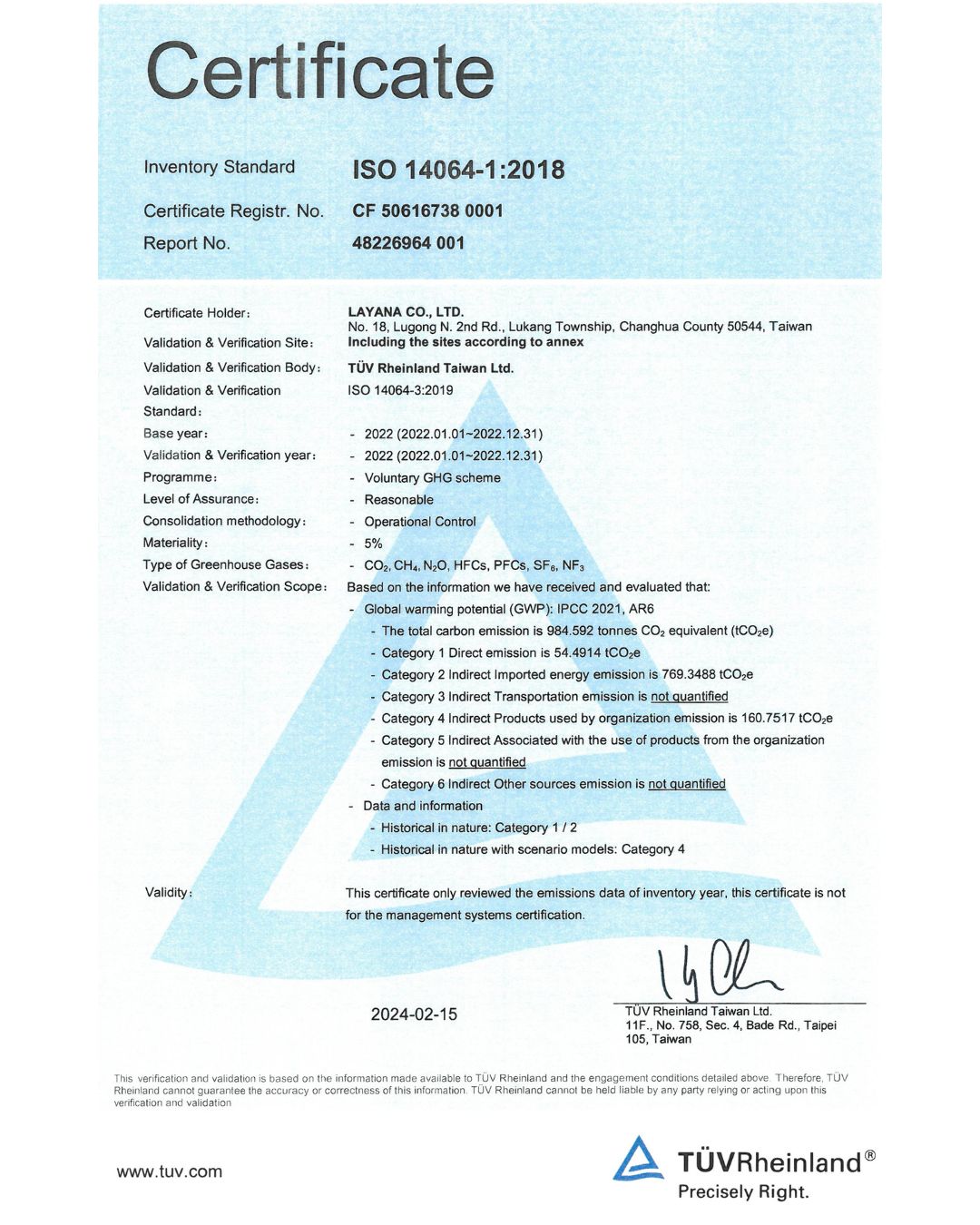 ISO 14064-1 Certificate
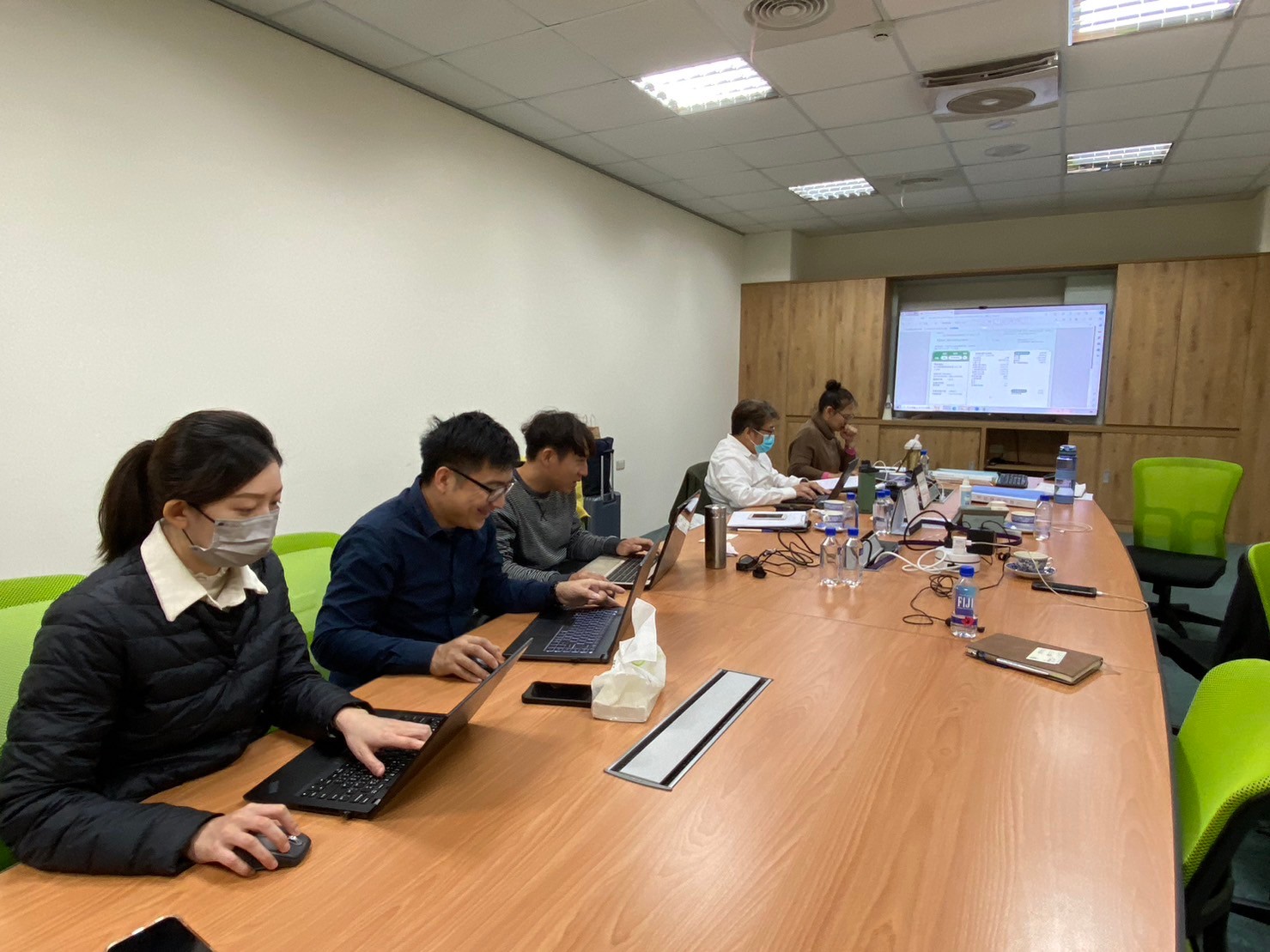 External ISO 14064-1 Audit