ISO 45001
Occupational Health & Safety, Certified
ISO 45001 is the world's reference standard for Occupational Health & Safety Management Systems — a structured way for a manufacturer to identify hazards, assess risk, comply with safety law and put controls in place to prevent harm. Here is what the standard is, the Plan–Do–Check–Act cycle Layana runs against it, and the resilience measures behind a safer, more reliable supply chain.
Navigation Jump to a Section
Key Takeaways
- ISO 45001 is the global standard for Occupational Health & Safety (OH&S) Management Systems — released in 2018, it replaced OHSAS 18001 and is now recognised in 179+ countries with nearly 400,000 certifications.
- At its heart is the PDCA cycle — Plan, Do, Check, Act — which embeds continuous improvement in workplace safety, with leadership involvement and active employee participation.
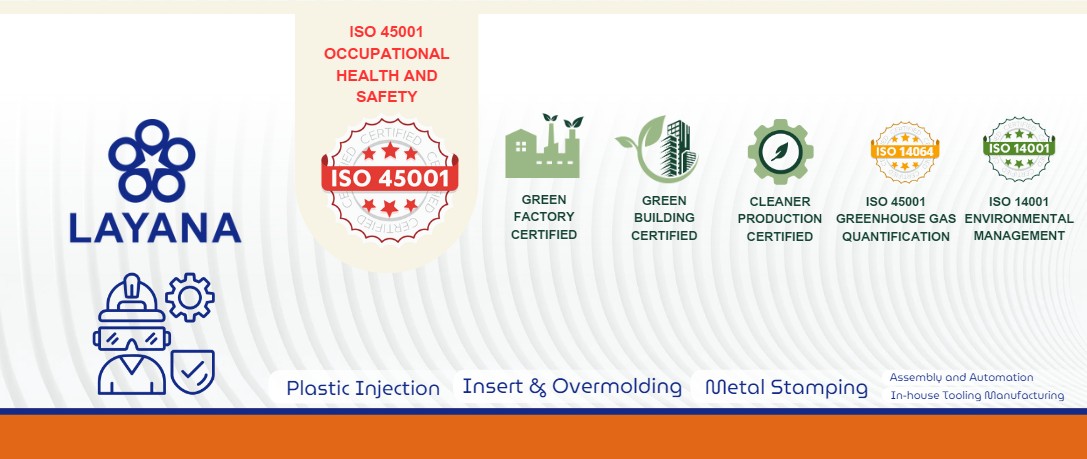
- Layana is ISO 45001 certified, paired with ISO 14001 (environmental management) and ISO 14064 (greenhouse gases), plus Taiwan's Green Factory, Green Building (EEWH-Gold) and Cleaner Production certifications.
- For buyers, sourcing from a certified OH&S partner means fewer accident-driven disruptions, a more ethical supply chain, and a safer environment for visiting clients and auditors.
- Layana goes further — industrial-scale rainwater storage, raft-foundation seismic resilience, automated storage rooms, cybersecurity firewalls and emergency response drills — toward the goal of zero accidents.
What Is ISO 45001?
ISO 45001 is the global standard for Occupational Health & Safety (OH&S) Management Systems. Released in 2018, it replaced the older OHSAS 18001 and is now the top OH&S standard worldwide. It pushes companies to spot hazards, assess risks, follow safety law and put controls in place to prevent harm — not just on paper, but as a working culture.
ISO 45001 is not just about rules. It requires leadership to step up and employees to get involved, making safety a core part of the business rather than a paperwork exercise. That is what separates a real OH&S system from a binder of policies that sits on a shelf.
The standard is recognised in over 179 countries and boasts nearly 400,000 certifications, demonstrating its widespread relevance across every industry where people work alongside machines, materials and processes. For Layana — an IATF 16949 metal-stamping and injection-molding manufacturer — it is the natural complement to ISO 14001: the same High-Level Structure, the same PDCA logic, but pointed at people instead of the environment.
The PDCA Cycle — How Layana Applies It
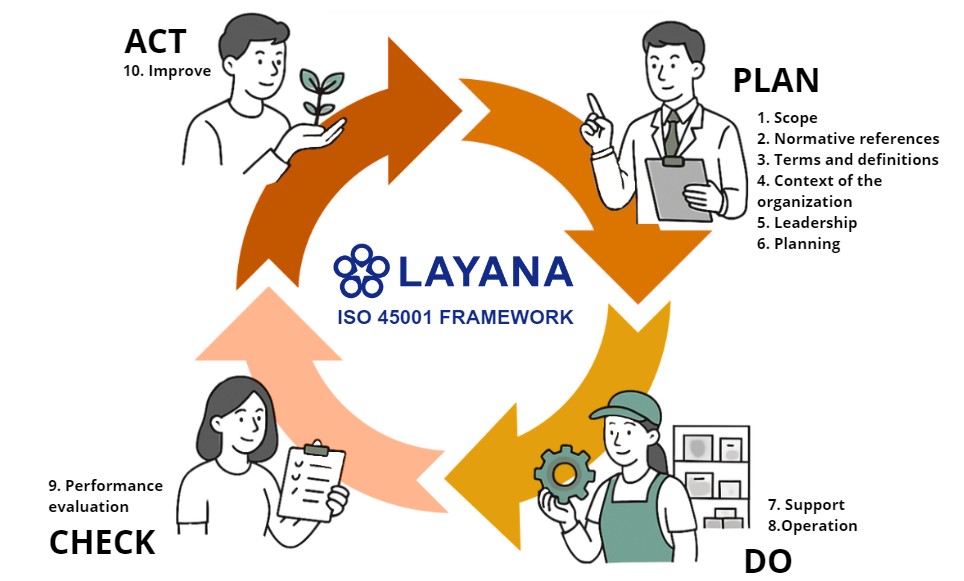
The four-stage Plan–Do–Check–Act loop is the operating logic of every ISO 45001 system. Together the four steps create a culture of continuous improvement so each pass through the cycle leaves the workplace a little safer than the last.
Plan
Identify safety objectives, assess potential workplace risks and hazards, evaluate legal requirements and plan the controls needed to prevent harm.
Do
Implement safety protocols, train employees, mitigate identified hazards and put emergency response plans into day-to-day practice.
Check
Monitor incidents, conduct internal safety audits, verify compliance with the OH&S system and the law, and feed results into management review.
Act
Layana leadership evaluates outcomes, addresses non-conformities and drives continual improvement so safety performance gets demonstrably better each cycle.
The PDCA cycle keeps safety efforts active and up to date — at Layana it is not a calendar event, it is how the factory runs.
Client & Partner Benefits of ISO 45001-Certified Manufacturing
When a manufacturer like Layana attains ISO 45001 certification, it does more than protect its own people — it delivers concrete value up and down the supply chain. Here is what Layana's clients and partners gain from sourcing from a certified OH&S supplier.
Legal Compliance & Fewer Disruptions
Layana's certification ensures it follows safety law, reducing the chance of accidents, penalties or shutdowns. Clients get a steady supply with no delays from safety incidents.
Better Reputation & Responsibility
Layana's focus on safety boosts its image as a responsible company. Clients benefit too — sourcing from ethical suppliers reinforces their own ESG narrative and stakeholder reporting.
Safer Collaboration & Less Risk
Layana's certified safety measures make the plant a secure place for visiting clients, engineers and auditors. Lower accident risk, lower liability, smoother and safer partnerships.
Supply-Chain Continuity
Emergency response plans, automated storage and offsite data backup translate into resilient, on-time delivery — even when something goes wrong upstream or on site.
Engaged, Trained Workforce
Active employee participation is required by ISO 45001 — the result is a more attentive workforce that catches issues early, making the parts you receive more consistent.
Continuous Improvement, Audited
The PDCA cycle is independently audited — buyers get evidence-backed assurance that safety performance keeps improving, not just promises in a tender response.
ISO 45001 vs Conventional Company
An aspect-by-aspect comparison of an ISO 45001 certified company (such as Layana) versus a conventional company running ad-hoc safety practices without a formal OH&S management system.
| Aspect | ISO 45001-Certified Company (e.g. Layana) | Conventional Company (No Formal OH&S System) |
|---|---|---|
| Safety Management | Structured and audited OH&S system with clear accountability. | Ad-hoc safety practices with inconsistent application. |
| Risk Identification | Proactive risk assessments and preventive measures. | Reactive responses to incidents; limited prevention effort. |
| Employee Involvement | Active employee participation in safety initiatives. | Top-down approach with minimal worker input. |
| Regulatory Compliance | Systematic, proactive legal compliance — often exceeds the minimum. | Basic compliance; risk of falling behind on regulatory updates. |
| Incident Management | Thorough investigations with root-cause analysis and corrective actions. | Superficial handling of incidents; limited organisational learning. |
| Continuous Improvement | Ongoing safety enhancements through structured audits and reviews (PDCA). | Little or no formal improvement process; change only after major problems. |
Layana's Resilience Measures Inside ISO 45001
In alignment with the philosophy and framework of ISO 45001, Layana has developed a comprehensive set of systems and protocols to strengthen resilience against accidents and emergencies. Several measures distinguish Layana from less resilient competitors and place it among the top preferred suppliers for reliability and performance.
Industrial-scale rainwater collection
Industrial-scale rainwater storage in the basement raft-foundation acts as a contingency plan, mitigating risks and costs from water-supply disruptions. See commercial rainwater collection system.
Raft-foundation seismic engineering
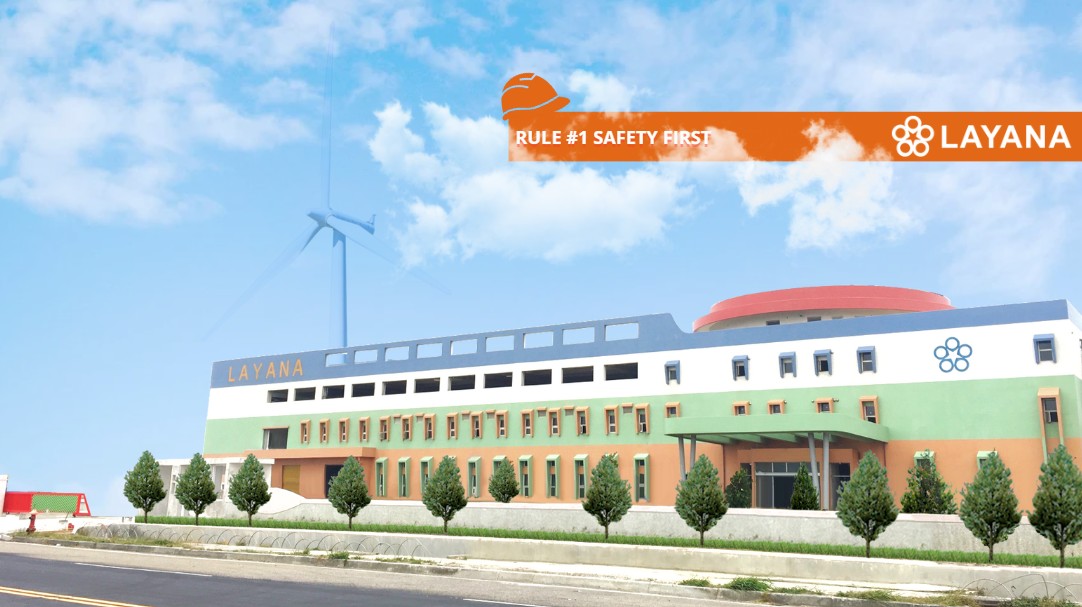
Raft-foundation engineering in the Green Factory building enhances structural resilience and risk prevention in the event of earthquakes.
Labour-shortage response plans
Immediate response plans for labour disruptions — cross-trained operators, written work-instructions and surge protocols — maintain operational continuity under workforce stress.
Cybersecurity firewalls & offsite backup
Robust cybersecurity firewall systems, daily offsite information backup and rigorous information management protect sensitive design and supplier data from cyber threats.
Supply-chain emergency response
Emergency response plans for supply-chain and purchasing interruptions, complemented by regular training and drills, ensure readiness when something goes wrong upstream.
Fully automated storage room
A fully automated storage room reduces labour accidents associated with goods and materials handling — physically removing the operator from the highest-risk movements.
These initiatives collectively reinforce Layana's commitment to operational excellence and long-term partnership with clients — and they sit on top of, not next to, the ISO 14001 EMS, ISO 14064 greenhouse-gas inventory and Taiwan's Green Factory, Green Building and Cleaner Production programmes.
Continuous Improvement in Health & Safety Performance
Achieving ISO 45001 is just the start — it is a commitment to ongoing improvement. The certificate marks the floor of Layana's safety performance, not the ceiling.
Layana regularly monitors its health and safety performance, using internal audits and management reviews to assess progress toward safety goals. Key metrics — injury rates, audit findings, corrective-action close-out times — are tracked to measure progress and set higher targets.
Following the PDCA cycle's "Act" phase, Layana makes changes whenever necessary to safeguard safety outcomes. This persistent effort ensures that, even with certification in hand, safety practices keep advancing — fostering a proactive safety culture focused on excellence, not complacency.
Layana's Wider ESG Certifications
ISO 45001 is Layana's safety backbone — but it sits inside a broader portfolio of environmental, energy and quality credentials that together describe a complete responsible-supplier profile.
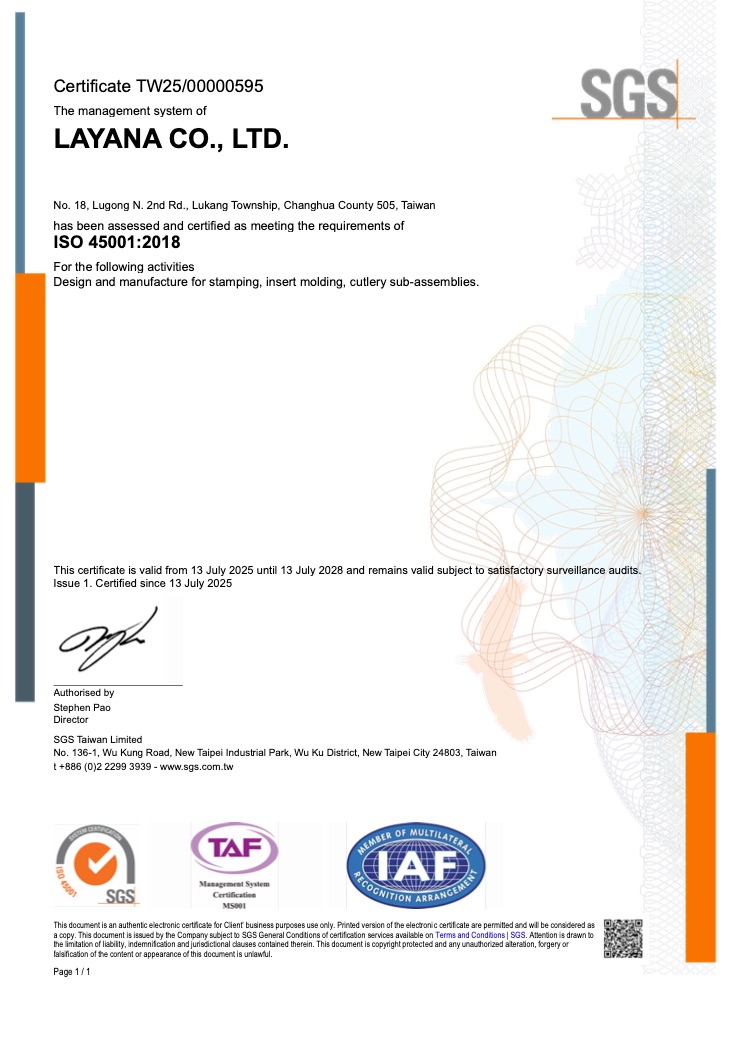
ISO 45001
Occupational health & safety management — the framework on this page.
You are hereISO 14001
Environmental management systems — the PDCA companion to ISO 45001.
ISO 14064
Greenhouse gas quantification, monitoring and reporting.
Green Factory
Taiwan's MOEA label — green building + cleaner production combined.
Green Building (EEWH-Gold)
EEWH-Gold certified factory (2018) — the hardware pillar.
Cleaner Production
General Industry Clean Production Assessment passed (2022).