Automatic Punching & Film Pasting Machine
Engineered, built and supported under one roof
A fully automated production line that punches, pastes film, inspects 100% of parts with AOI vision and tape-and-reel packages output — replacing manual labor, stabilizing quality, and feeding the process data that Industry 4.0 demands.
Navigation Jump to a Section
Key Takeaways
- Fully unmanned production — feeding, punching, film pasting, inspection and packaging run continuously without operator intervention.
- 100% AOI inspection — twin industrial vision cameras verify hole size, position and film symmetry on every part, replacing statistical sampling.
- Industry 4.0-ready data — CSV inspection logs and PLC event records feed traceability, MES and predictive-maintenance systems.
- Hundreds of parts/hour per machine — high-speed throughput from a single line, scalable across a production floor.
- Designed and built by Layana's in-house R&D team — from concept and mechanism design through controls, integration and lifetime support.
Why Automate Punching and Film Pasting
Manual film pasting and punching are exactly the kind of repetitive, high-precision tasks where human variance, fatigue and a global labor shortage compound into real quality and cost problems. Layana's automatic punching and film pasting machine was developed to eliminate that bottleneck — and at the same time turn the production line into a continuous source of process data that powers smart manufacturing.
As the manufacturing industry upgrades toward Industry 4.0, automation equipment combined with in-line data collection becomes the foundation for improving process quality. The line not only raises efficiency — it captures production data at every stage. The resulting big data, once analyzed, supports better production decisions, optimized equipment configurations, predictive fault detection and true smart manufacturing.
Layana's custom automation team designs equipment around your part, not around a generic frame. We have decades of experience building progressive and transfer dies for world-class OEMs, and the same engineers integrate stamping, component assembly and inspection into a single connected line.
The result is a machine that solves a labor shortage problem today and a data infrastructure problem tomorrow — without the integration risk of stitching together three separate vendors.
In-house automation R&D — mechanism, controls and software designed by Layana engineers.
Tooling workshop — punches, dies and fixtures built and serviced internally for fast iteration.
Vision & AOI integration — image analysis tuned to your part's defect modes, not off-the-shelf templates.
Lifetime support — local engineers for installation, training, spare parts and process optimization.
Eliminating manual labor through automated equipment is no longer optional in the era of labor shortage — it is the foundation that makes Industry 4.0, traceability and predictive maintenance possible.
Operating Process Overview
The machine integrates feeding, punching, indexing, film application, AOI inspection and tape-and-reel packaging into one continuous flow — coordinated by a central PLC and a graphical HMI. Six core stages, no manual handoff.
System Subsystems in Detail
Each subsystem is designed, built and tuned in-house — so the punch, the divider, the vision system and the controls all speak the same language from day one. Expand each card for the engineering detail.
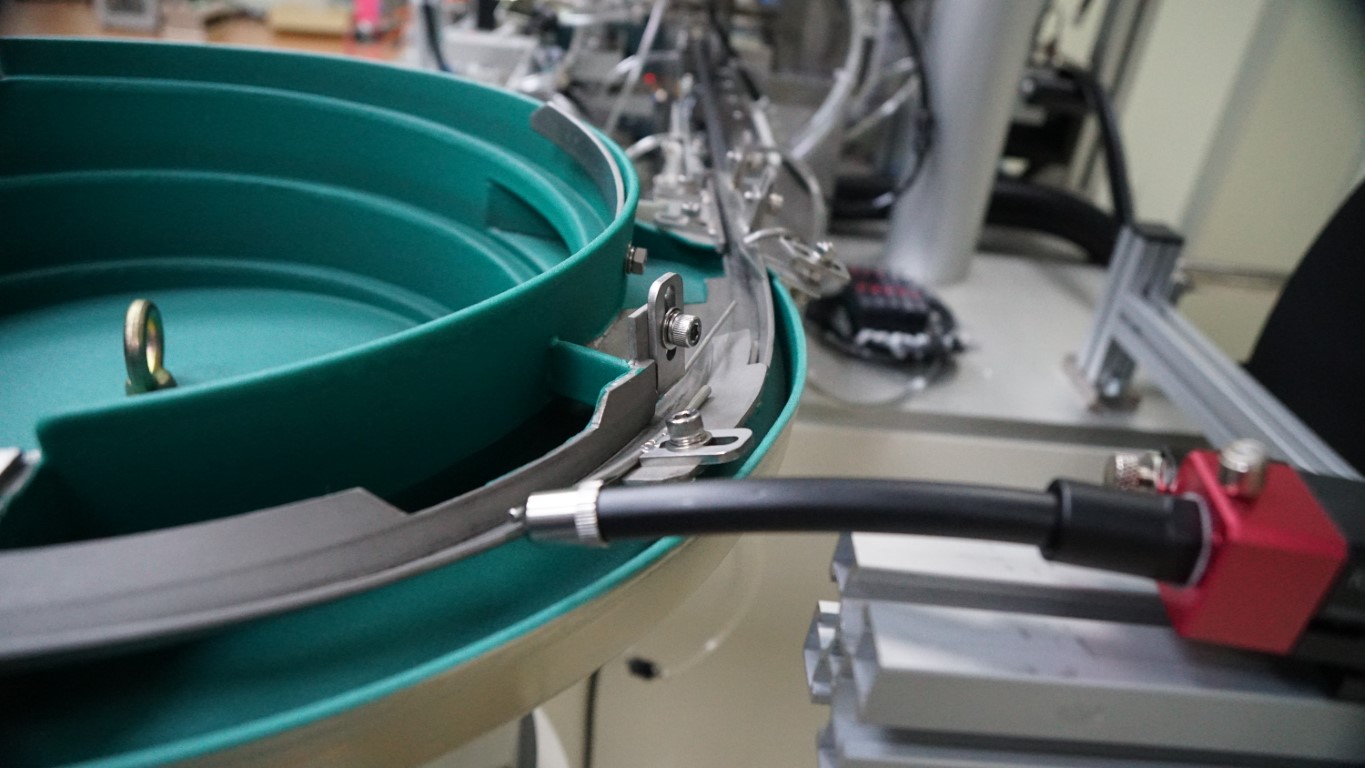
Metal parts to be punched and pasted are loaded into the vibration plate in bulk. By controlling vibration frequency, the parts are scattered, aligned and delivered to a flat conveyor that feeds the next station.
The result is automatic, continuous and uninterrupted feeding with no manual intervention — the foundation on which the rest of the line's throughput depends.
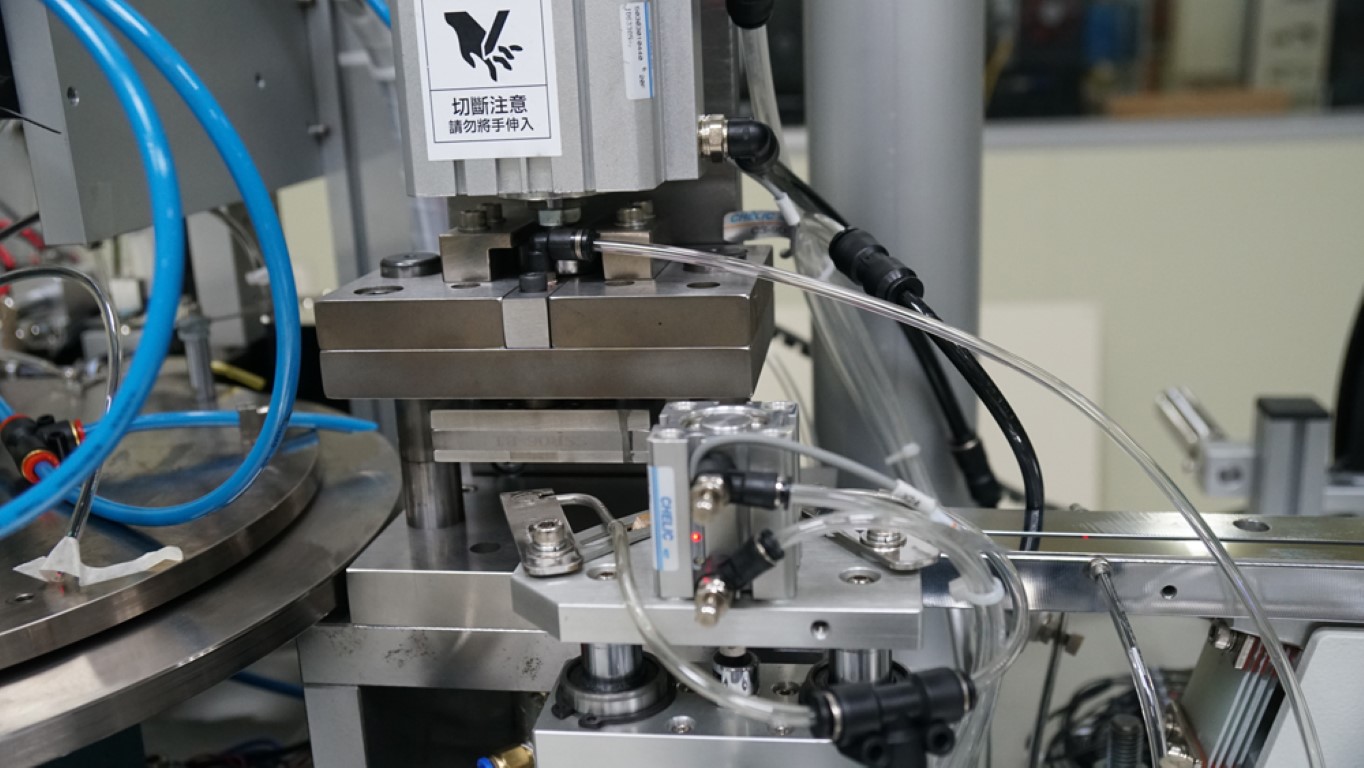
The punching process is completed at high speed by a press equipped with upper and lower precision guide pillars. The punch and mold are designed for fast disassembly and replacement of the punching consumables, keeping changeover time low.
A punch-stroke counter monitors tool wear in real time and automatically stops the machine when the punch reaches the end of its useful life — a critical safeguard for dimensional stability over long production runs.
A 12-axis mechanical-divider disc mechanism, driven by a variable-frequency motor at adjustable speed, indexes each part to the exact processing position. Positioning accuracy is extremely high and stable in production — the prerequisite for both punch alignment and film-pasting symmetry downstream.
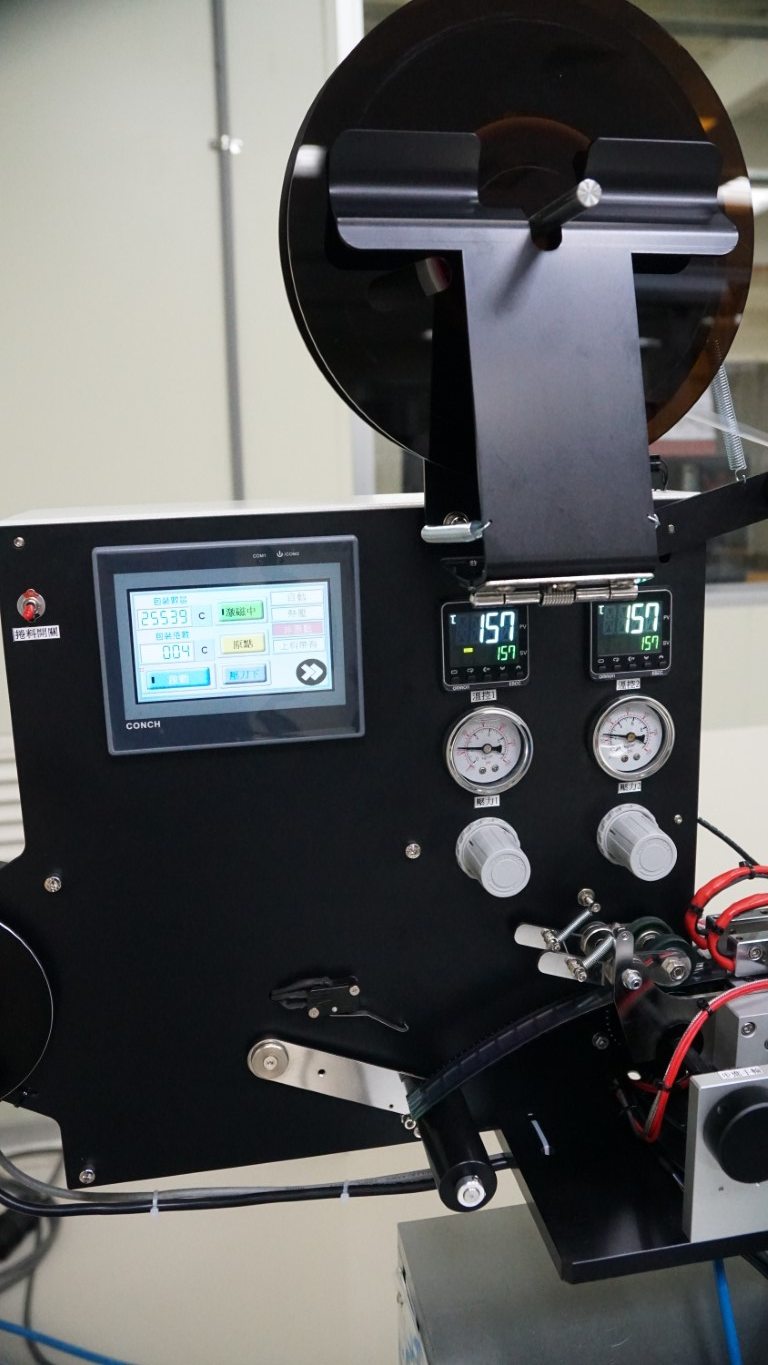
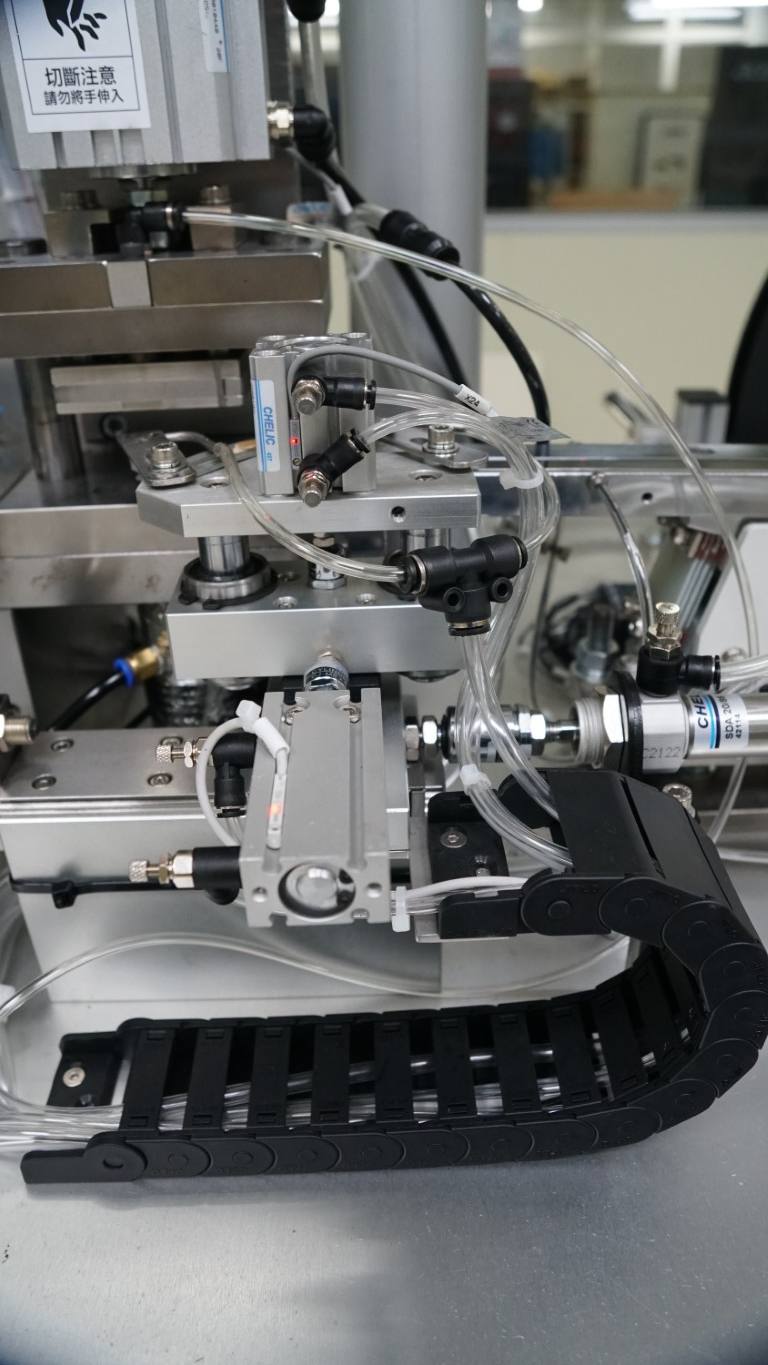
Film is fed by a small segmented mechanism with positioning beads, advanced to the bonding position, and accurately attached to the part surface by vacuum suction cups. The entire sequence is unmanned — no operator touches the film or the part — which removes one of the largest sources of cosmetic and adhesion defects in manual lines.
Two industrial-grade vision cameras with dedicated light sources inspect every part after punching and after film pasting. Image analysis software measures hole size, hole position and film symmetry against the specification.
Any NG (defective) part triggers an automatic signal that diverts it into a reject slot, eliminating the risk of missed detection inherent in manual sampling — and unlocking real 100% in-line inspection.
An automatic arm transfers good parts to the tape-and-reel packaging system, which cuts, packs and reels to a user-defined count — ready for the next process. The result is neat, orderly finished-goods packaging that drops directly into downstream electronic-component assembly.
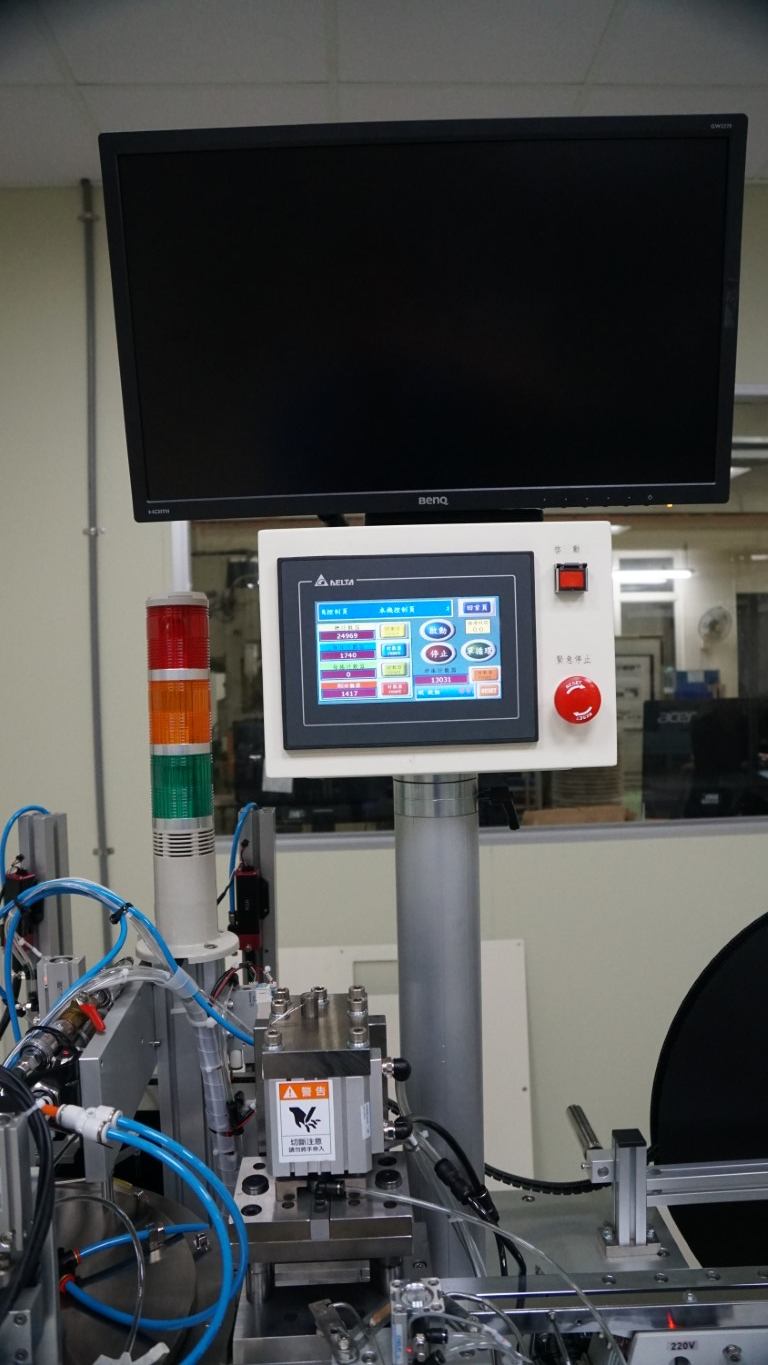
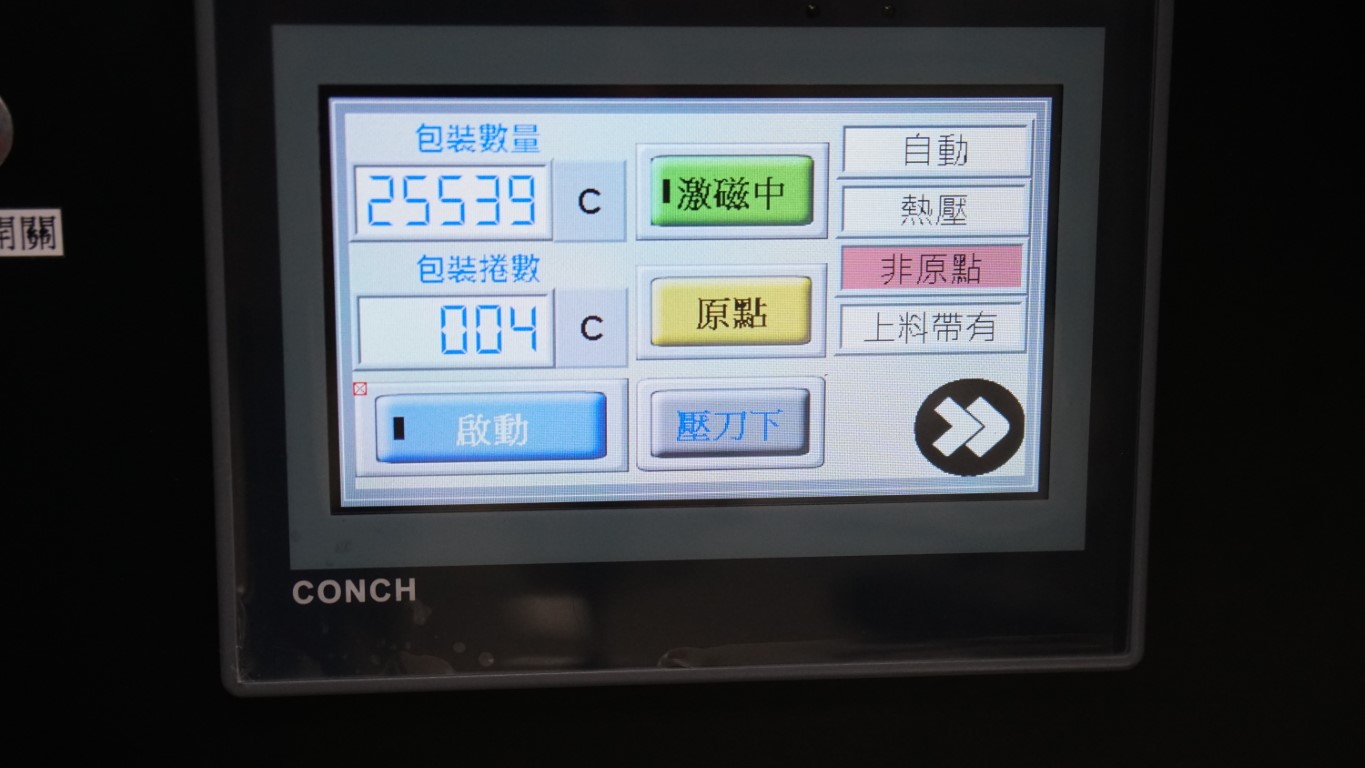
A touchscreen HMI lets operators start, stop and parameterize the entire line through simple graphical options — no programming knowledge required. The same screen shows live machine status and statistical information, so production supervisors can read line health at a glance.
Advantages of the Layana Line
The business case is built on four pillars — throughput, quality, data and operability. Together they translate into a measurable drop in cost per good part and a measurable rise in process visibility.
Efficient, Fully Automated Production
End-to-end automated flow from feeding through film pasting to packaging eliminates manual labor. Throughput in the hundreds of parts per hour from a single machine, scaled across the floor as needed.
Precise, Verifiable Quality
Punching size and film-pasting symmetry held within tolerance to the drawing specification. Machine vision monitors hole and film position in real time and isolates defective parts immediately — 100% inspection, not statistical sampling.
Process Data for Industry 4.0
The AOI system generates CSV inspection records — date, time, size and symmetry — and the PLC logs every operating event. Reports support product traceability, process optimization and predictive maintenance.
Easy Operation & Maintenance
Graphical HMI and modular mechanical design mean operators do not need special training. Maintenance access is engineered into the layout, dramatically lowering ongoing operating cost.
Applications & Industries Served
The architecture transfers across any small-part production task that requires punching, surface bonding, inspection and reel packaging — particularly where the end use is electronics or precision components.
Electronic Components
Connectors, contacts, shielding and small terminals that need a punched feature and a protective or insulating film.
Automotive Electronics
Sensors, terminals and shielding components for EV power electronics and ADAS modules that demand 100% inspection.
Consumer Electronics
High-volume small parts for smartphones, wearables and IoT devices — where reel packaging hands off to SMT assembly.
Industrial & Telecom
Precision components for industrial controls, telecom and power equipment where traceability and zero-defect output matter.
Operating Specifications & Requirements
Indicative operating envelope for the standard machine — every project is configured to the customer's part geometry, throughput and quality target.
| Parameter | Specification | Notes |
|---|---|---|
| FeedingVibration plate | Continuous, unmanned | Bulk loading; vibration frequency tuned to part geometry |
| PunchingPress & die | High-precision, guide-pillar | Quick-change punches with consumable counter and auto-stop on wear |
| Indexing12-axis divider | Variable speed, high accuracy | VFD-driven mechanical divider for repeatable positioning |
| Film PastingVacuum suction | Automatic, no manual touch | Segmented feed with positioning beads; vacuum-cup application |
| InspectionAOI vision | 2 cameras, 100% in-line | Hole size, hole position, film symmetry; auto NG diversion |
| PackagingTape & Reel | Programmable reel count | Automatic transfer arm; ready for downstream SMT |
| Air PressurePlant supply | ≥ 5 kgf/cm² | Required for vacuum systems and pneumatic actuation |
| CleanroomProduction env. | Recommended | End use is electronic components; debris control is essential |
| LightingAOI env. | Stable ambient | Required to prevent vision interference; controlled enclosure preferred |
What to Plan For Before Installation
A short engineering-honest list of the factors that determine whether the line hits its expected uptime and yield from day one.
Adequate Plant Air Pressure
Multiple vacuum systems depend on a stable air supply. We recommend > 5 kgf/cm² at the machine inlet to avoid intermittent suction failures.
Punch Consumable Strategy
The punch is a consumable. The integrated counter auto-stops the line when wear reaches the set threshold — keep spare punches on hand to keep changeover under minutes.
Cleanroom-Level Cleanliness
Because the end products are electronic components, install the line in a cleanroom or controlled environment to prevent debris from contaminating the punched and pasted surfaces.
Stable Ambient Lighting
The AOI inspection runs at 100% — and is only as good as its environment. Stable brightness around the camera enclosure prevents false positives and missed defects.
Why Layana for Custom Automation
This machine exists because Layana already had the engineering ingredients in-house: decades of stamping experience, an automation R&D team, a tooling workshop, and software partners ready to extend the line into MES, ERP and predictive analytics.
Layana has an excellent automation R&D team that designs and develops complete automation equipment — from scheme design through mechanism development, controls, verification and debugging. We provide customized manufacturing and processing solutions, and partner with software equipment suppliers to develop increasingly intelligent automation lines.
Because we are also a precision metal stamping and injection molding manufacturer ourselves, every machine we deliver is informed by our own production floor experience. We know what fails in three shifts of continuous running — and we engineer it out before shipping.
In the future, Layana will continue to leverage our internal R&D and our long-term part-production capacity to provide customers with more automation and intelligent solutions — bringing higher production efficiency and product quality to your operation.
One-roof engineering — concept to commissioning with a single accountable team.
Tooling & consumables in-house — punches, fixtures and spares supported locally.
IATF 16949 quality system — automotive-grade discipline applied to every project.
Long-term partnership — automation, stamping and molding capacity that scales with you.
Let's design the automation your product actually needs.
Share your part drawings and throughput target — our engineers will return a feasibility outline, conceptual layout and indicative timeline. No template proposals; every machine is configured to your part.