Titanium Stamping for Precision Components
Unrivaled Innovation and Reliability
From mission-critical aerospace structures to life-saving medical implants — a complete engineering guide to titanium, its alloys, and how Layana masters one of the industry's most demanding materials under one roof.
Navigation Jump to a Section
Key Takeaways
- Titanium delivers the strength of steel at roughly 45% less weight, with a natural oxide layer that gives it exceptional corrosion resistance and biocompatibility.
- Titanium's low elastic modulus and high work-hardening rate cause significant springback and galling — the two defining challenges of titanium stamping.
- CP Grades 1-4 offer the best formability for deep-drawn parts; Ti-6Al-4V (Grade 5) and its ELI variant (Grade 23) trade formability for strength and medical-grade ductility.
- Layana’s vertically integrated manufacturing platform combines progressive-die stamping, plastic injection molding, insert molding and overmolding under one roof, enabling coordinated production of complex metal, plastic and bi-material components.
- Layana is IATF 16949, ISO 14001 and ISO 45001 certified, and holds its region's first Green Factory Certification — engineering and producing titanium components under one roof.
Titanium stamping is the foundation of modern, high-performance manufacturing, delivering the high-strength, lightweight and corrosion-resistant components required by the world's most demanding industries. From mission-critical aerospace and automotive parts to life-saving medical devices, the ability to precisely form titanium alloys is crucial for technological advancement. However, titanium's inherent properties — high strength, low ductility and extreme springback — make it one of the most difficult materials to form, necessitating elite engineering expertise, rigorous process control and advanced technology.
In this landscape of high-stakes precision, Layana Company stands as a strategic and indispensable manufacturing partner. Built on decades of experience in high-precision stamping, in-house tooling and full vertical integration, Layana possesses the engineering acumen and advanced automated systems necessary to master complex materials like titanium. Our comprehensive approach — integrating Design for Manufacturability (DFM) with cutting-edge automation and a commitment to controlled production quality — provides a secure pathway for global OEMs to transform their most ambitious designs into reliable, market-ready products.
Layana's Integrated Solution for High-Performance Manufacturing
Layana's core commitment is to deliver a seamless, end-to-end manufacturing solution that accelerates time-to-market, reduces total cost of ownership, and guarantees long-term product reliability. This integrated model is engineered specifically to overcome the intrinsic challenges of titanium stamping, where success hinges on the control and precision of every stage — from initial tooling design to final inspection.
By consolidating tooling, stamping, plastic injection molding and automated assembly under one roof, Layana ensures unparalleled control, production flexibility and absolute accountability across the full lifecycle of a titanium component.
Tooling workshop — in-house die design, CNC, Wire EDM and precision grinding.
Simulation — FEA modeling of springback, material flow and stress concentration.
Mass production — automated high-tonnage presses with in-line AOI inspection where specified.
Hybrid assembly — insert molding and multi-shot molding integrated with stamped titanium.
Layana's Distinct Advantages in Precision Stamping
Layana's capacity to consistently deliver high-quality, dependable results in the most challenging applications stems from a set of distinct competitive advantages that govern the entire product's lifecycle.
True Vertical Integration
We manage tooling and die design, fabrication, stamping, plastic injection molding and automated assembly internally — eliminating the delays and quality risks of coordinating multiple suppliers.
Advanced Engineering & R&D
Our engineering team applies DFM and DFMEA to optimize designs from the start — essential for predicting and compensating for titanium's springback before a die is ever cut.
Hybrid Manufacturing Expertise
Mastery of insert molding, reel-to-reel and multi-shot molding allows stamped titanium to be seamlessly integrated with engineered plastics.
Sustainable Manufacturing
As a certified Green Factory, Layana embeds ESG principles throughout operations — energy-efficient systems, closed-loop water recycling and active carbon-footprint management.
Layana's Certifications and Global Credibility
Trust and compliance form the cornerstone of Layana's partnerships with major global OEMs. Our operations and quality management system are validated by internationally recognized standards.
IATF 16949
Certified for the global automotive industry, guaranteeing robust process control and quality assurance for demanding applications.
ISO 14001
Validates Layana's effective Environmental Management System (EMS), confirming our commitment to sustainable operations.
ISO 45001
Ensures a world-class Occupational Health and Safety Management System, prioritizing the well-being of the Layana team.
Green Factory Certification
We were the first company in our region to receive this certification — verified achievements in clean production, energy efficiency and circular resource management.
What Is Titanium Stamping?
Titanium stamping is a specialized metal-forming process that shapes titanium alloy sheets or coils into precise, three-dimensional components. A high-tonnage mechanical or hydraulic press forces a custom-designed die set onto the titanium workpiece, causing controlled bending, stretching and forming into the desired shape.
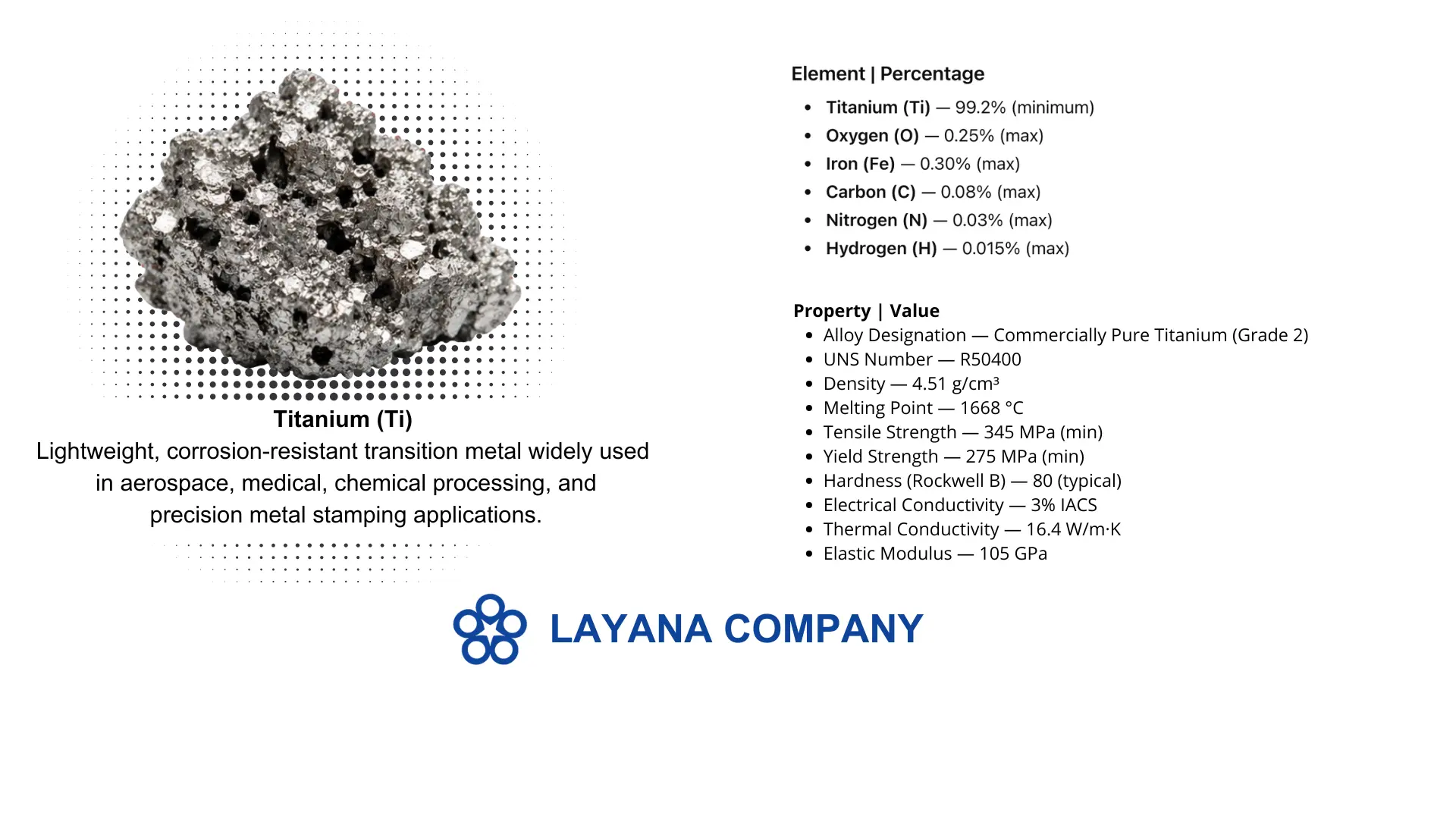
Unlike more conventional metals such as steel or aluminum, titanium's unique combination of high strength, low elastic modulus and significant work hardening makes it exceptionally challenging to stamp. Successfully stamping titanium demands an expert-level understanding of its material science, exceptionally robust and precise tooling, and tightly controlled press parameters. Key challenges — galling (material adhering to the die surface), springback (the material's tendency to partially return to its original shape) and the potential for cracking — must be systematically mitigated through expert engineering and advanced process monitoring. Layana's proficiency in DFM and in-house tooling is critical to designing processes that master these difficulties from the outset.
How Does Titanium Compare with Steel and Aluminum?
Understanding where titanium sits relative to the two most commonly stamped metals explains both why OEMs specify it — and why it demands a specialist stamping partner. The table below compares representative annealed-sheet values.
| Property | Titanium (CP Gr. 2) | Stainless Steel (304) | Aluminum (5052-H32) |
|---|---|---|---|
| Densityg/cm³ | 4.51 — ~45% lighter than steel | 8.00 | 2.68 |
| Tensile StrengthMPa, typical | ~345 | ~515 | ~230 |
| Elastic ModulusGPa | ~103 — low modulus drives springback | ~193 | ~70 |
| Strength-to-Weight | Excellent — the defining advantage | Moderate | Good |
| Springback in Forming | High — requires FEA over-bend compensation | Moderate | Low to moderate |
| Corrosion Resistance | Outstanding — self-healing passive oxide layer | Good; vulnerable to chlorides | Good; often anodized |
| Biocompatibility | Excellent — implant-grade | Limited (nickel content) | Not implantable |
| Galling Tendency | Severe — needs coated tooling & lubricants | Moderate | Low |
| Relative Material Cost | High | Low–moderate | Low |
The takeaway: titanium wins decisively on specific strength, corrosion resistance and biocompatibility, but its low elastic modulus, galling behavior and raw-material cost mean the economics only work when scrap is minimized and forming succeeds the first time. That is precisely where Layana's in-house tooling and simulation-driven DFM pay for themselves.
A Brief History of Titanium: From Cornish Sand to the EV Era
Titanium is a young engineering metal — commercially viable for barely 80 years. Its trajectory from laboratory curiosity to aerospace icon to mass-market material explains why stamping expertise in titanium remains rare.
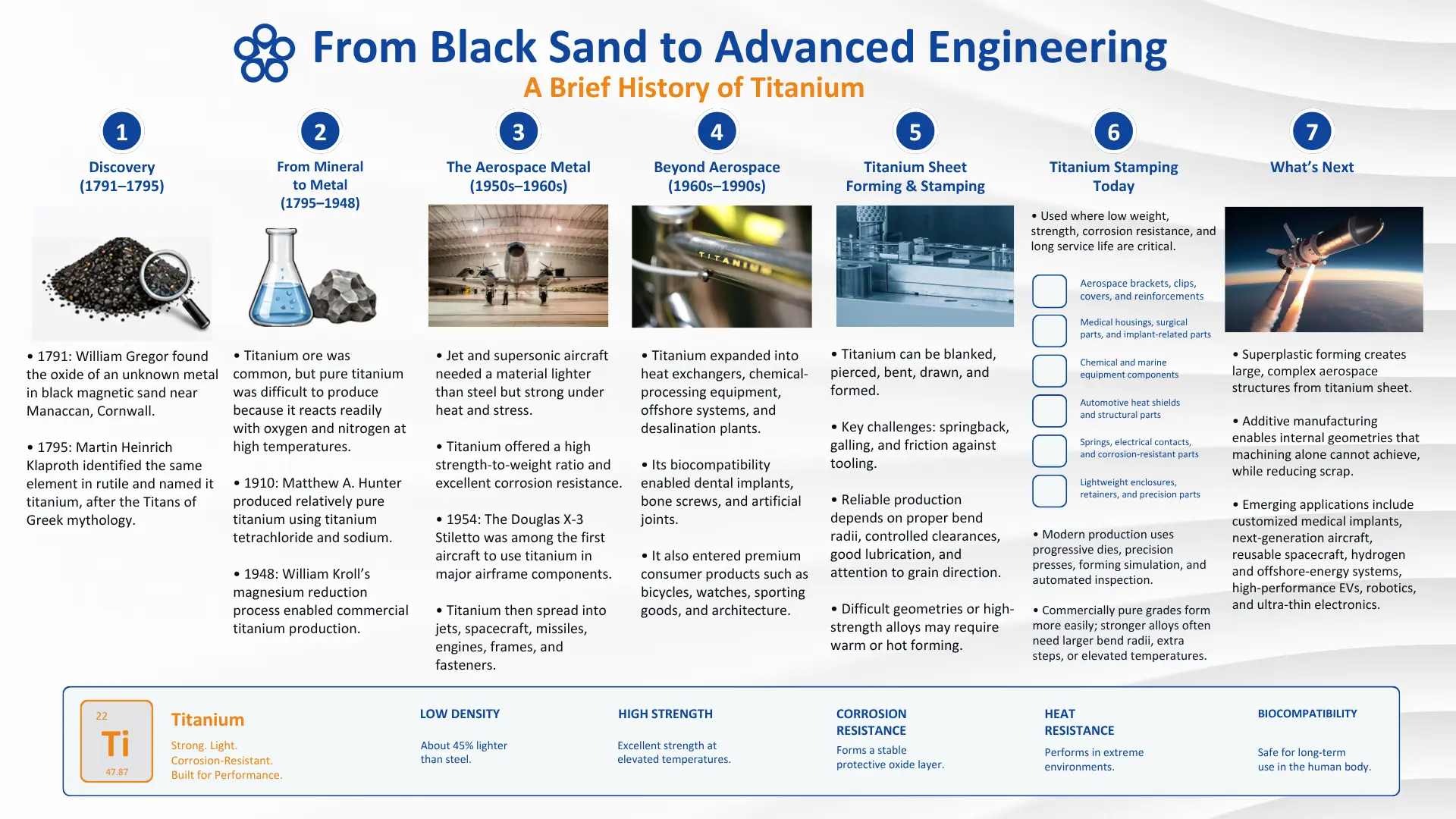
An Unknown Element in Black Sand
Amateur geologist and clergyman William Gregor identifies an unknown metallic element in the black magnetic sand of Cornwall, England — the mineral later named ilmenite.
Named After the Titans
German chemist Martin Heinrich Klaproth independently discovers the element in rutile ore and names it titanium, after the Titans of Greek mythology — a fitting name for the strength it would later demonstrate.
The Hunter Process
Metallurgist Matthew Hunter produces 99.9% pure titanium for the first time by reducing titanium tetrachloride with sodium — proof that the metal could be isolated, though not yet at industrial scale.
The Kroll Process
William Kroll patents magnesium reduction of titanium tetrachloride — the breakthrough that makes commercial titanium production viable. The Kroll process remains the dominant production route today.
Cold War Aviation Pushes the Limits
Military aviation drives massive investment in titanium metallurgy, and Ti-6Al-4V is developed in 1954 — still the world's most-used titanium alloy.
Example: The Lockheed SR-71 Blackbird's structure was roughly 85% titanium, chosen to survive sustained Mach 3+ skin temperatures.
The Implant Standard
Titanium's biocompatibility and osseointegration make it the default material for orthopedic and dental implants. Extra-Low Interstitial Ti-6Al-4V ELI (Grade 23) is standardized for surgical use.
Premium Consumer Products
Falling processing costs bring titanium into watches, eyewear, sporting goods and high-end electronics — where its feel, durability and finish command premium positioning.
Precision Stamping at Scale
Electrification and lightweighting bring titanium into EV battery enclosures, power electronics and smartphone frames — applications that demand high-volume, tightly controlled stamping rather than one-off machining. This is the era Layana's automated titanium stamping lines are built for.
Types and Categories of Titanium Stamping
The term "titanium stamping" covers several specific forming operations, each suited for different component geometries and complexities. The optimal process depends on the titanium alloy grade, part thickness and final application requirements.
Commonly stamped titanium alloys include Commercially Pure (CP) Grade 2 for its good formability and corrosion resistance, and Ti-6Al-4V (Grade 5) for applications demanding exceptional strength-to-weight ratios — though it is significantly more challenging to form. See the alloy comparison table below for a full breakdown.
Advantages and Limitations of Titanium Stamping
Despite the manufacturing difficulties, components produced through titanium stamping offer distinct advantages that make them indispensable in high-performance applications — balanced against real technical hurdles that require specialized expertise to manage.
Unparalleled Benefits
Strength-to-Weight
Titanium delivers the strength of steel while weighing approximately 45% less — ideal for reducing mass in aerospace, automotive and portable electronics.
Corrosion Resistance
A stable, protective oxide layer resists saltwater, aggressive industrial chemicals and bodily fluids — the premier material for marine, chemical and medical implant applications.
Biocompatibility
Non-toxic and highly tolerated by the human body, making titanium the default material for surgical implants, orthopedic devices and dental fixtures.
High-Temperature Performance
Titanium alloys maintain strength and structural properties at elevated temperatures where aluminum would fail — suitable for engine and exhaust components.
Technical Hurdles to Overcome
| Challenge | Why It Happens | How Layana Mitigates It |
|---|---|---|
| High Material Cost | Titanium is significantly more expensive than conventional metals | Nesting optimization and scrap-reduction DFM to minimize waste |
| Significant Springback | Low elastic modulus causes the material to spring back after forming | FEA simulation and over-bend compensation built into die design |
| Galling | Titanium cold-welds to the die surface under pressure | Specialized tool coatings, advanced lubricants and precise process control |
| High Tooling Wear | Extreme forming forces wear down stamping dies rapidly | High-strength tool steels, in-house robust die fabrication, proactive maintenance |
| Low Ductility / Work Hardening | Titanium cracks easily if formed too aggressively | Appropriate bend radii and multi-stage, progressive forming operations |
The Layana Titanium Stamping Process and Methodology
Layana executes titanium stamping projects through a systematic, quality-driven methodology that tightly integrates engineering, production and automation — ensuring every component consistently meets exact specifications.
Common Titanium Alloys for Stamping
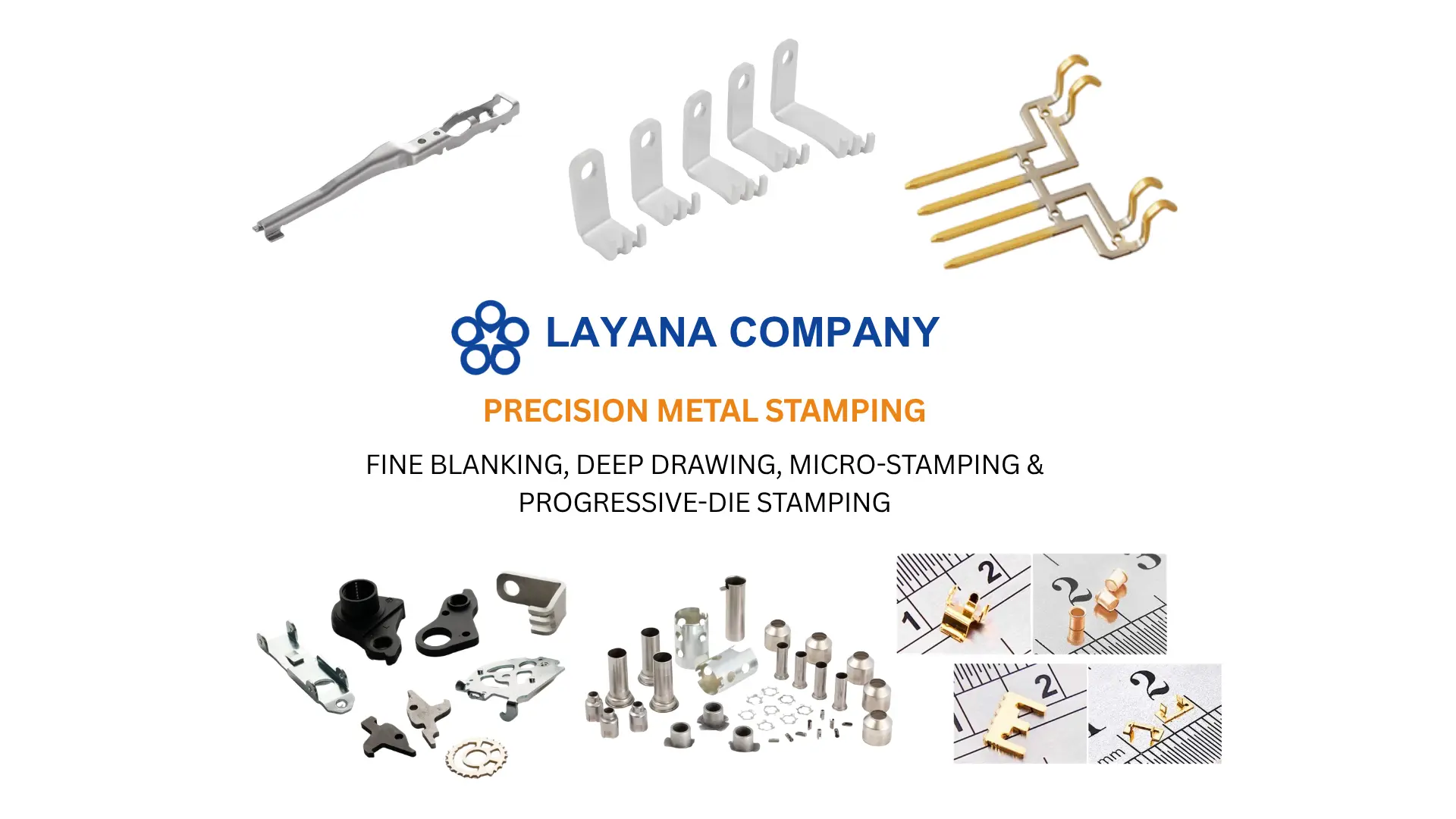
Titanium alloys sit on a spectrum from highly formable Commercially Pure grades to high-strength alpha-beta and beta alloys. Choosing the right grade means trading formability against strength, temperature capability and cost.
The Four Titanium Alloy Families
Grade-by-Grade Comparison
| Grade / UNS | Classification | Key Properties | Stamping Notes | Typical Applications |
|---|---|---|---|---|
| CP Grade 1UNS R50250 | Commercially Pure (α) | Softest, most ductile CP grade; lowest strength (~170 MPa min. tensile); excellent corrosion resistance | Best formability of any titanium grade — ideal for deep drawing and tight bend radii | Chemical processing equipment, deep-drawn housings, medical trays |
| CP Grade 2UNS R50400 | Commercially Pure (α) | Best balance of formability, strength (~345 MPa min. tensile) and corrosion resistance; the industry-standard CP grade | Highly formable with predictable, moderate springback — the default choice for stamped titanium | Airframe skins, marine hardware, heat exchangers, architectural panels |
| CP Grade 3UNS R50550 | Commercially Pure (α) | Higher strength than Grade 2 (~450 MPa min. tensile) with slightly reduced ductility | Moderate formability; requires more generous bend radii and process control than Grade 2 | Aerospace fittings, cryogenic vessels, pressure-critical components |
| CP Grade 4UNS R50700 | Commercially Pure (α) | Highest-strength CP grade (~550 MPa min. tensile); lower ductility than Grades 1-3 | Formable but springback and cracking risk are elevated — needs careful DFM and tooling design | Airframe components, surgical instruments, high-strength fasteners |
| Ti-6Al-4V (Grade 5)UNS R56400 | Alpha-Beta | ~895 MPa min. tensile — roughly double CP strength; the most widely used titanium alloy overall | Significant springback and galling risk; requires FEA-driven over-bend compensation and specialized lubrication | Structural aerospace parts, EV battery/BDU enclosures, high-performance automotive components |
| Ti-6Al-4V ELI (Grade 23)UNS R56401 | Alpha-Beta (Extra-Low Interstitial) | Same nominal composition as Grade 5 with lower oxygen/iron content, giving improved ductility and fracture toughness | Slightly more forgiving to form than standard Grade 5, though still demanding | Orthopedic implants, surgical devices, biocompatible structural parts |
| Ti-3Al-2.5V (Grade 9)UNS R56320 | Near-Alpha | Moderate strength (~620 MPa min. tensile) between CP and Grade 5, with good weldability | Good formability for tubing and thin-wall stamped parts; commonly supplied as coil/strip | Hydraulic and pneumatic tubing, sporting goods, aerospace ducting |
Minimum tensile-strength values are representative of ASTM/ASME specifications for annealed sheet and may vary with supplier, product form and heat-treat condition. Layana's engineering team selects the exact grade, temper and specification (e.g. AMS, ASTM B265) to match each application's mechanical, corrosion and regulatory requirements.
Selecting the right titanium grade is a stamping decision as much as a materials decision — Layana's DFM process weighs formability, springback behavior and final mechanical requirements before a single die is cut.
Products, Applications, and Industries Served
Layana's expertise in precision stamping is directly applicable to the manufacturing of high-performance titanium components across diverse industries where component failure is not an option.
Automotive & EV
Lightweighting structural components, high-performance exhaust flanges, engine valve retainers, and protective casings for battery and power-electronics modules.
Medical Devices
Surgical instruments, orthopedic implants (bone plates and screws), dental fixtures, and casings for implantable electronic devices like pacemakers.
Power Electronics & Industrial
Heat sinks, shielding components, connectors and sensor housings for environments demanding extreme corrosion resistance and durability.
Consumer Electronics
Premium aesthetic, feel and durability for high-end smartphone frames, laptop casings and wearable device components.
Related Layana Resources
Titanium stamping is one part of Layana's vertically integrated manufacturing platform. Explore how our capabilities, quality systems and sustainability program come together.
Manufacturing Solutions
Precision metal stamping, plastic & bi-material injection molding, and total engineering — one facility, every discipline.
Quality Management & Assurance
IATF 16949, Six Sigma, in-line inspection and continuous improvement — how quality is engineered into every component.
Green Factory Certification
Layana's sustainable manufacturing journey — the first Green Factory-certified company in our region.
Copper Metal Stamping
A companion engineering guide to copper — history, properties, alloys and applications in precision stamping.
FAQ — Titanium Stamping
References & Standards
Material properties and specifications cited in this guide are drawn from the following industry standards and reference works.
- ASTM B265 — Standard Specification for Titanium and Titanium Alloy Strip, Sheet, and Plate. ASTM International.
- AMS 4911 — Titanium Alloy Sheet, Strip, and Plate, 6Al-4V, Annealed. SAE International.
- ISO 5832-3 — Implants for Surgery — Metallic Materials — Part 3: Wrought Titanium 6-Aluminium 4-Vanadium Alloy. International Organization for Standardization.
- ASM Handbook, Volume 14B — Metalworking: Sheet Forming. ASM International.
- Leyens, C. & Peters, M. (eds.), Titanium and Titanium Alloys: Fundamentals and Applications. Wiley-VCH.