Quality Assurance — Quality Engineered in Every Layer, Not Just Inspected at the End
At Layana, quality is the paramount principle. We manage and control it across four dimensions — people, environment, supply chain and product — through an IATF 16949:2016 quality management system, seven structured improvement methods and a complete toolkit (APQP, Control Plan, PFMEA, PPAP, MSA, SPC, GR&R, Six Sigma and 6S). The result for our customers: predictable parts, audited suppliers and a documented commitment to continuous improvement.
Source From a Manufacturer That Treats Quality as a System
In automotive, EV, aerospace and energy supply chains, the difference between a good supplier and a problem supplier is rarely the parts on the first PPAP — it is how the supplier behaves over the next thousand shipments. Layana's QA program is built so that quality stays consistent at scale: standards documented, audits regular, suppliers held to the same bar, and every measurement traceable.
- Quality controlled across 4 dimensions — people, environment, supply chain and product
- IATF 16949:2016 — the automotive QMS standard, not a generic ISO 9001
- Top 5 suppliers audited for system, process and product
- MSA-validated calibration on every instrument — measurements you can trust

Key Takeaways
- Layana's quality policy prioritizes quality above all else and controls it across four dimensions: personnel, environment, supply chain and product.
- The quality management system is based on IATF 16949:2016, with departmental objectives and standard operating procedures revised by team input.
- Quality is operationalized through seven continuous-improvement methods: education & training, internal audits, supplier audits, equipment calibration, customer satisfaction, standard development and continuous improvement.
- The toolkit includes APQP, Control Plan, PFMEA, PPAP, MSA, SPC, GR&R, Six Sigma and 6S — a complete set of automotive-grade quality methods.
- Seven independent certifications back the program: IATF 16949:2016, ISO 14001 Environmental Management, ISO 14064 Greenhouse Gas Quantification, ISO 45001 Occupational Health & Safety, Green Building (Gold), Green Factory and Cleaner Production System.
Navigation Jump to a Section
Layana's Quality Policy
Layana, guided by the paramount principle of prioritizing quality, comprehensively manages and controls quality across every part of the business. Upholding the belief in continuous improvement, the company strives to enhance overall quality and efficiency through the collective effort and collaboration of every team member.
The standard is not just to meet customer requirements — it is to exceed them. To achieve this, the quality policy is grounded in the requirements of the IATF 16949:2016 Automotive Quality Management System. With input from all team members on matters of quality, Layana revises and establishes departmental quality objectives and implements standard operating procedures that align the entire organization with the concept of sustainable business operations.
Quality Controlled Across Four Dimensions
Layana's quality assurance is not limited to the inspection room. It spans every input to the business — because a quality output requires quality everywhere upstream.
Personnel
Trained, certified, accountable. Quality starts with people who understand the standard.
Environment
Clean facility, calibrated equipment, controlled conditions — a stable workplace for stable processes.
Supply Chain
Suppliers audited at system, process and product level so upstream quality matches downstream demand.
Product
Engineered, measured, monitored — and shipped only when it meets the documented inspection standard.
An IATF 16949:2016 Quality Management System
Layana operates its quality management system based on IATF 16949:2016 — the global Automotive Quality Management System standard. It is the foundation on which every QA decision is made, every audit is structured and every improvement is measured.
Because IATF 16949 builds on ISO 9001 and adds automotive-specific requirements — APQP, PFMEA, MSA, PPAP and SPC — it gives Layana and its customers a single shared language for quality, traceability and continuous improvement across every program.
To learn how the standard itself works — its origin, the five core tools, the certification process and Layana's 20+ year IATF 16949 history — read our dedicated IATF 16949 explainer.
Seven Methods for Continuous Improvement
The QMS is only as good as the rhythm that keeps it running. Layana operationalizes IATF 16949 through seven structured methods executed every quarter, every cycle, every shipment.
Education & Training
IATF 16949 quality training courses are run regularly to strengthen every employee's understanding and application of the five core tools — APQP, PFMEA, MSA, PPAP and SPC.
Internal Audits
Each department consolidates its operational indicators and schedules IATF 16949 internal audits to verify correct implementation. Any issue triggers corrective action and root-cause analysis.
Supplier Audits
System, process and product audits are performed on the top five suppliers, with regular assessments of their supply level — ensuring the upstream chain meets the same standard customers expect downstream.
Equipment Calibration
Instrument calibration is scheduled and verified with Measurement System Analysis (MSA) — analyzing the variation and characteristics of each measurement system to guarantee instrument reliability and product quality.
Customer Satisfaction
Customer satisfaction surveys identify the gap between actual experience and customer expectations. Every area of dissatisfaction becomes an input for improvement — and a step toward sustainable business growth.
Standard Development
Quality inspection standards are developed and continuously refined. The rules used at every checkpoint are reviewed, optimized and re-documented — ensuring inspection always reflects current customer requirements.
Continuous Improvement
Cross-departmental team discussions stimulate structured brainstorming and analysis — using the full Six Sigma and QCC toolset to drive measurable improvement toward customer requirements.
Layana's Quality Management Toolkit
A complete set of automotive-grade quality methods — the same toolkit IATF 16949 requires, applied consistently across every line and every program.
| Tool | Full Name | What It Does |
|---|---|---|
| APQP | Advanced Product Quality Planning | Plans the steps and deliverables required to ensure the final product satisfies the customer — quality designed in from day one. |
| Control Plan | Control Plan | A documented description of the methods, measurements and reactions used to keep every process step within specification. |
| PFMEA | Potential Failure Mode & Effects Analysis | A systematic review of new or revised processes to anticipate, address and monitor potential failure modes before they cause defects. |
| PPAP | Production Part Approval Process | The formal approval checklist proving a supplier has understood the customer's design records and can produce parts to spec consistently. |
| MSA | Measurement System Analysis | Evaluates the entire measurement process — instruments, gauges, methods, software, people, environment — for reliability and traceability. |
| SPC | Statistical Process Control | Uses statistical techniques such as control charts to monitor a process and act to achieve, maintain and improve a state of statistical control. |
| GR&R | Gage Repeatability & Reproducibility | Quantifies how much of the variation in a measurement comes from the gauge or operator vs. the part itself — a key MSA component. |
| Supplier ISO | Supplier ISO Certifications | Verified ISO certification status across the upstream supply chain — non-negotiable for tier-one and tier-two material and service vendors. |
| Six Sigma | Six Sigma DMAIC + DMADV | Data-driven methodology to reduce defects toward 3.4 DPMO. Layana runs an in-house belt program with 25 certified practitioners. Read more → |
| 6S | 6S 5S + Safety | Sort, Set in Order, Shine, Standardize, Sustain — plus Safety. A workplace discipline that keeps the floor clean, organized and safe so quality stays repeatable. |
Certifications That Back the System
Seven independent, audited credentials reinforce the quality program — covering product quality, environmental management, carbon accounting, worker safety, green facility performance, cleaner production and the working environment.
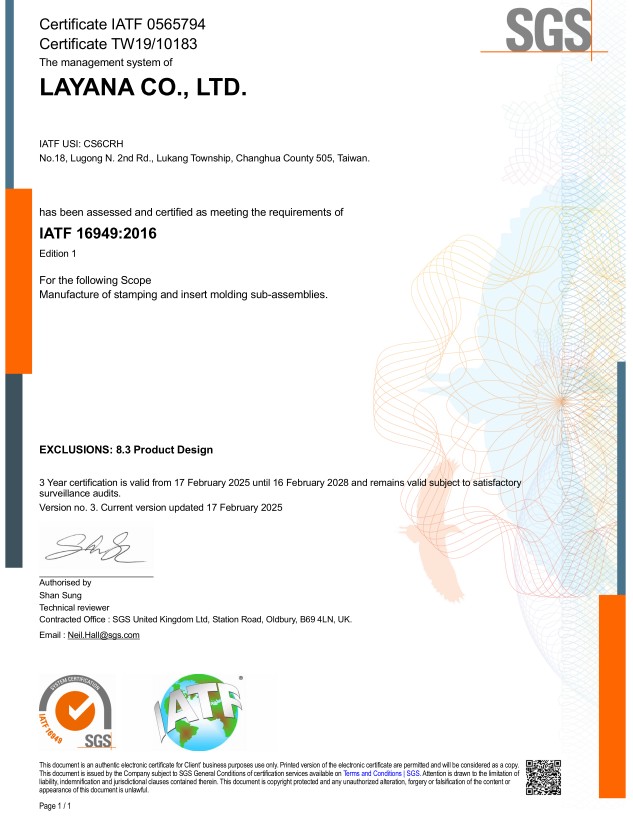
IATF 16949
International Standard for Automotive Quality Management Systems — the backbone of Layana's QMS.
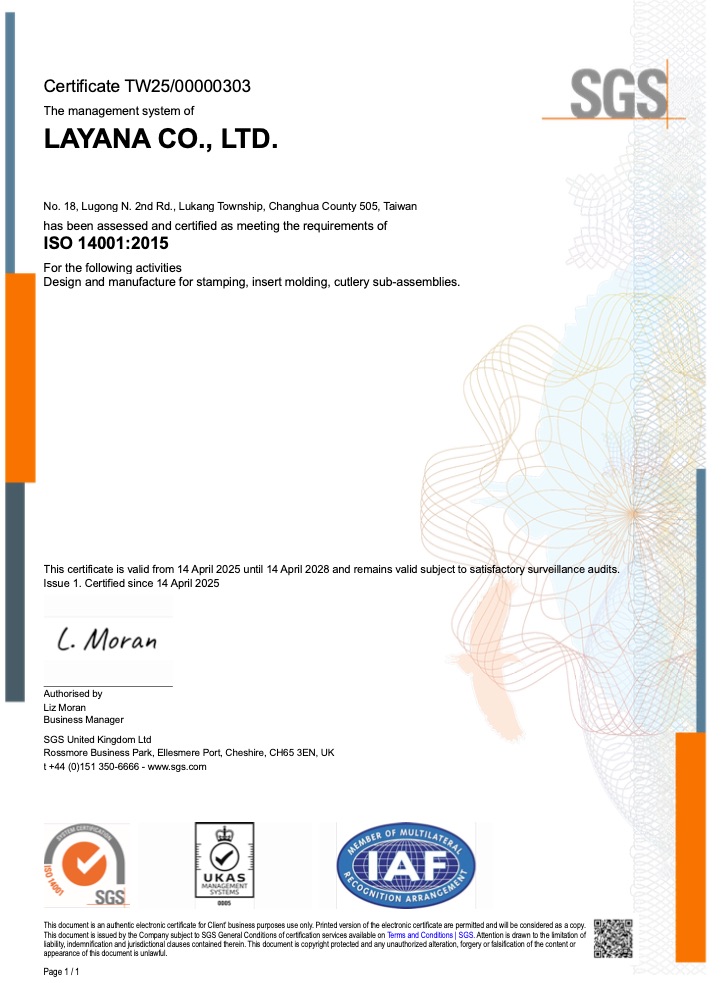
ISO 14001
Environmental Management System — systematic identification, control and reduction of every operational environmental impact.
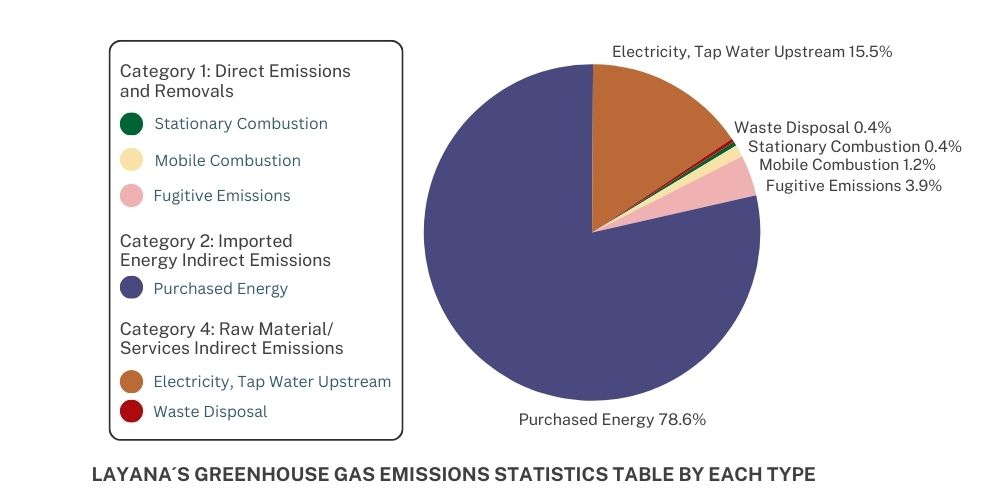
ISO 14064
Greenhouse Gas Quantification & Verification — a verified GHG inventory that makes carbon footprint measurable, reportable and reducible.
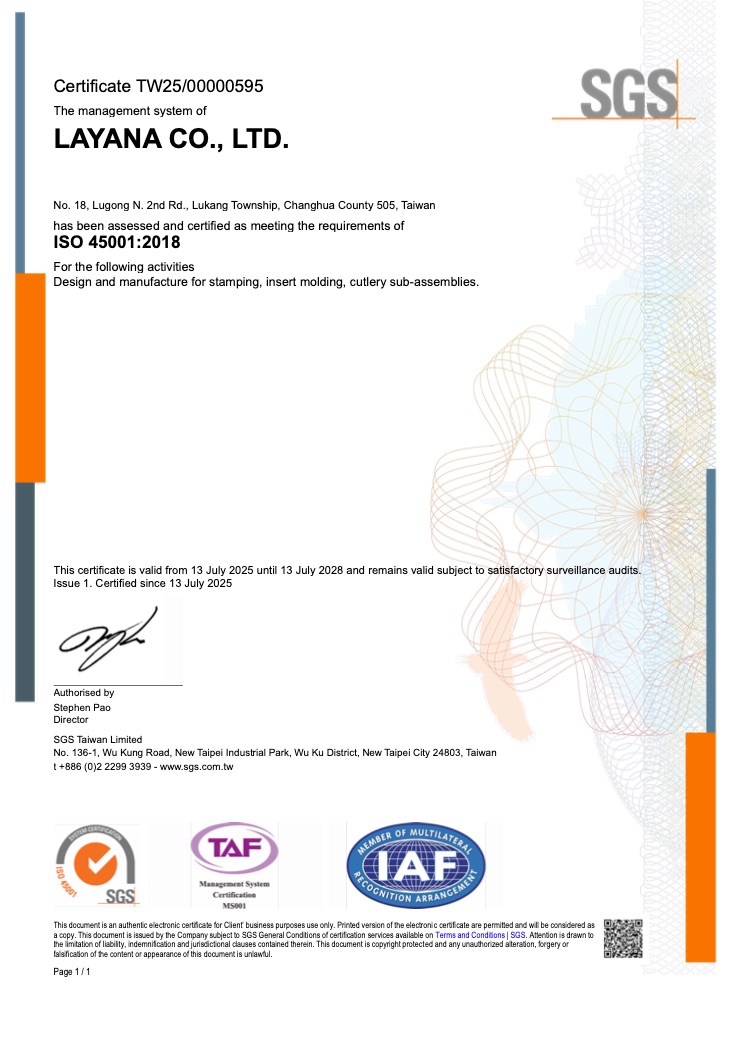
ISO 45001
Occupational Health & Safety Management System — engineered workplace risk control and a documented safety-first culture on the shop floor.
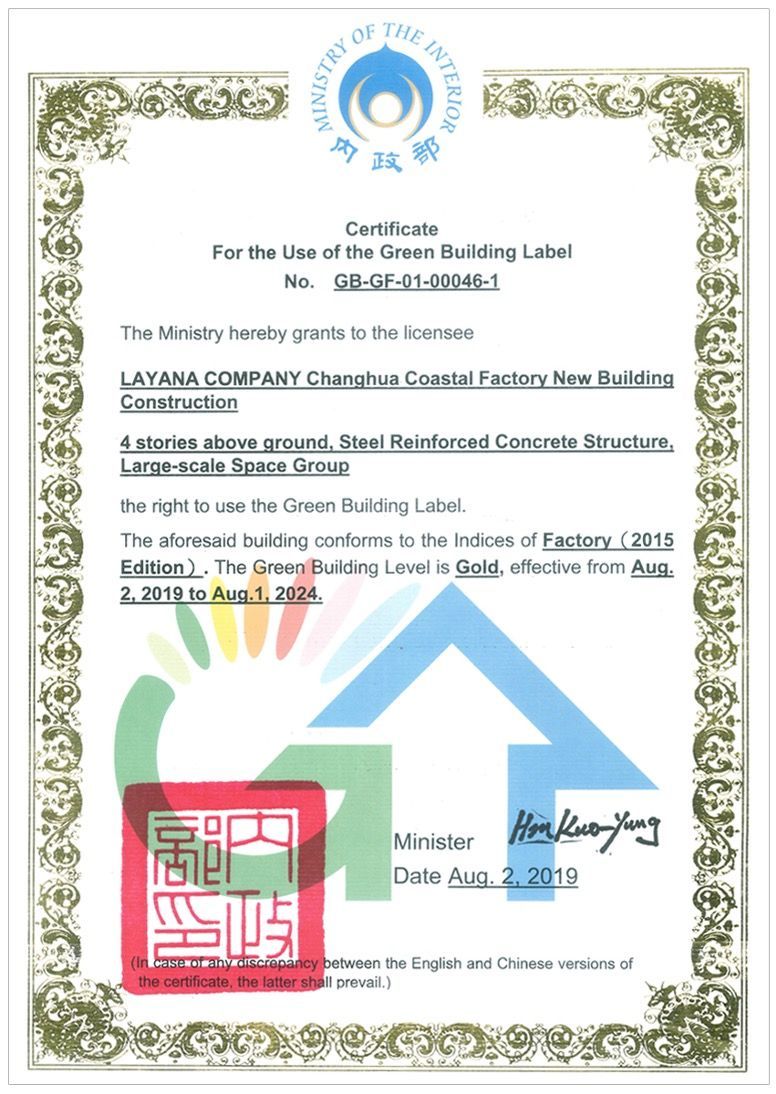
Green Building (Gold)
Gold-level Green Building certification at Layana's Lukang headquarters — a controlled, sustainable workplace for stable processes.
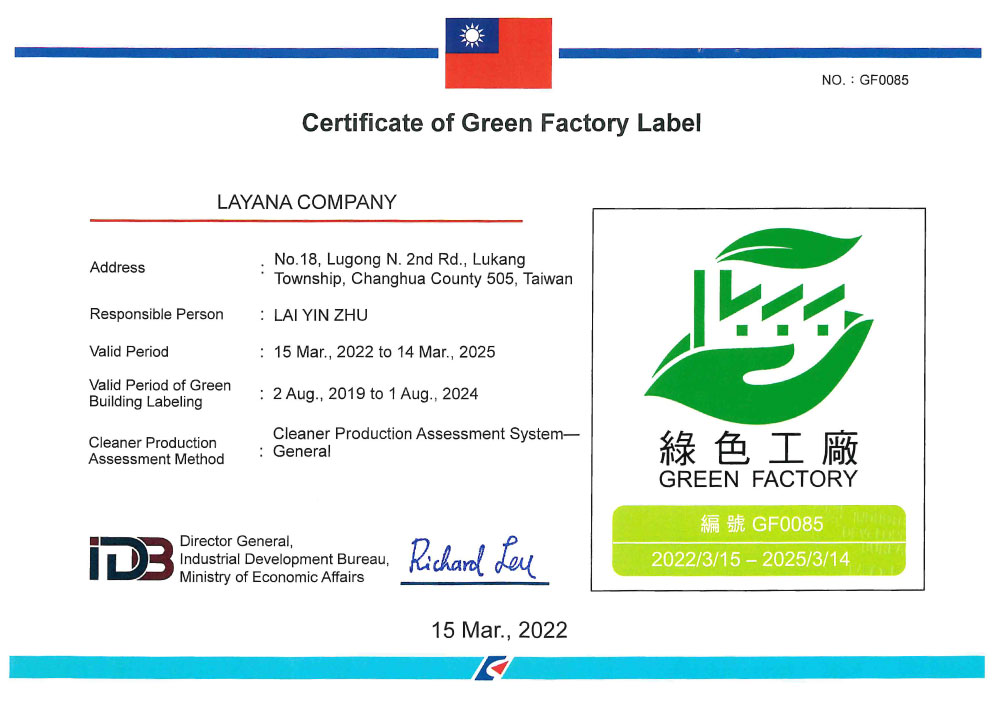
Green Factory Certification
Green Factory certification verifies Layana's factory management and environmental performance, reinforcing low-carbon, resource-efficient manufacturing.
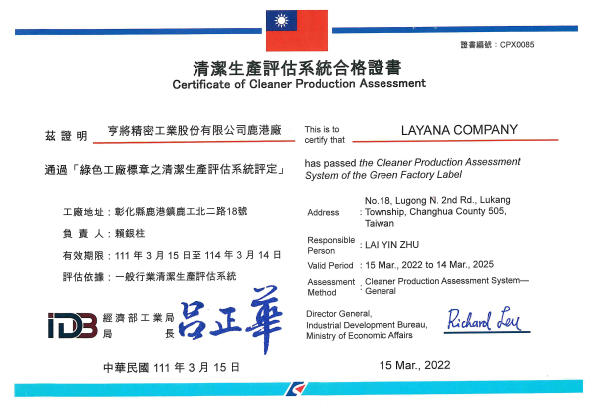
Cleaner Production System
Cleaner Production System certification supports waste reduction, resource efficiency and cleaner operations across Layana's manufacturing processes.
Quality Is How We Work, Not What We Audit
A quality system is only as good as the daily behavior it produces. At Layana, the policy of "quality first" is enforced by an IATF 16949:2016 QMS, executed through seven structured methods, and verified by a toolkit of automotive-grade quality tools — every one of them in active use, not just on a wall poster.
For customers, the practical result is a supplier whose quality, environmental, carbon, worker-safety, green-factory and cleaner-production practices are independently certified, whose suppliers are audited at three levels, whose instruments are MSA-validated, and whose improvement cycle never stops. Predictable upstream — predictable downstream.
"Meet customer requirements — then exceed them."
— Layana Quality PolicyFrequently Asked Questions about Quality Assurance
Layana prioritizes quality as its paramount principle, managing and controlling quality across four dimensions — personnel, environment, supply chain and products. The QA program is built on the IATF 16949:2016 Automotive Quality Management System, operationalized through seven continuous-improvement methods and a full toolkit including APQP, Control Plan, PFMEA, PPAP, MSA, SPC, GR&R, Six Sigma and 6S.
Layana's QMS is based on IATF 16949:2016 — the global automotive quality management system standard. Departmental quality objectives, standard operating procedures and continuous improvement cycles are all designed to comply with and exceed IATF 16949 requirements.
1) Education and training on IATF 16949 and the five core tools. 2) Internal audits with corrective action and root-cause analysis. 3) Supplier audits of the top five suppliers. 4) Equipment calibration with MSA. 5) Customer satisfaction surveys. 6) Standard development for inspection rules. 7) Continuous improvement through cross-departmental team discussions.
Layana's QMS toolkit includes APQP (Advanced Product Quality Planning), Control Plan, PFMEA (Potential Failure Mode and Effects Analysis), PPAP Checklist, MSA (Measurement System Analysis), SPC (Statistical Process Control), GR&R (Gage Repeatability & Reproducibility), Supplier ISO certifications, Six Sigma, and 6S (5S + Safety).
Layana's QA program is reinforced by IATF 16949:2016 (Automotive Quality Management System), ISO 14001 (Environmental Management System), ISO 14064 (Greenhouse Gas Quantification), ISO 45001 (Occupational Health & Safety Management System), Green Building Gold-level certification, Green Factory certification and Cleaner Production System certification — independently verified credentials that span product quality, environmental management, carbon accounting, worker safety, green facility performance, cleaner production and the working environment.
Layana conducts system, process and product audits on its top five suppliers and regularly assesses their supply level. This ensures the upstream supply chain meets the same quality standards Layana is responsible for delivering to its customers.